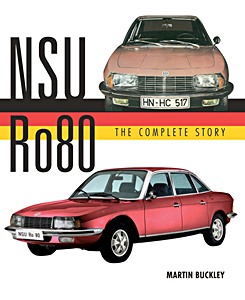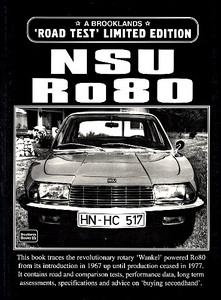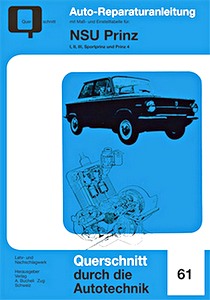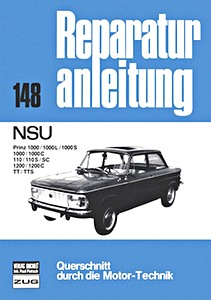
Launched in 1967, the NSU Ro80 had modern aerodynamic styling, a technologically advanced Wankel rotary engine and was voted Car of the Year in 1968. However, after the initial positive reception, the car developed a reputation for unreliability, with problems arising as early as 15,000 miles and many vehicles required a rebuilt engine before 30,000 miles. Despite the company resolving these reliability issues in both existing and new vehicles, and offering a generous warranty, the damage to the car's reputation was done.
The NSU Ro80 is the most celebrated motoring lost cause of the second half of the twentieth century, outranking the likes of the Edsel and the DeLorean because, unlike those statements of misplaced optimism and ego, it was a good car. Not just good: the NSU Ro80 is one of the great saloons. Launched in September 1967, the Ro80 was an all-new four-door five-seater from a West German company that - post-war - had never made anything other than economy runabouts, motorcycles and mopeds.
That alone should have been enough of a risk, but this was also the world's first purpose-built Wankel-engined family saloon. This compact, refined and elegantly simple power unit was the first really new concept in the realm of internal combustion engines to achieve mass production for ninety years. A car like the Ro80 could only really have come from Germany, where there was a passion for research and a pride in engineering not found elsewhere in Europe. With front-wheel drive, superb power steering and four-wheel disc brakes, the car had top handling and driver appeal. Quite simply, it was a masterpiece, considered by many to be the finest vehicle of its type in the world. But with one fatal flaw: its engine. With over 300 archive photographs, drawings and diagrams, this book tells the story of the NSU.
Product details
Author:
Martin Buckley
Details:
176 pages, 26 x 21.5 x 1.9 cm / 10.25 x 8.5 x 0.75 in, hardback
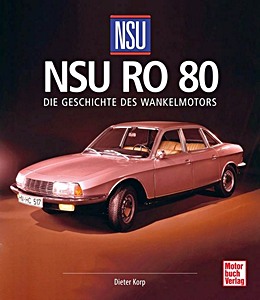
The Ro 80 symbolizes the utopia of the 1960s like no other car, but its initial enthusiasm quickly faded. The revolutionary engine, whose prototype featured a rotating piston for the first time on April 13, 1954, failed due to customer rejection, resistance from the established automotive industry, the crises of the time, and ultimately, the lack of interest from NSU's new owners in the concept.
Author and witness Dieter Korp created a comprehensive and unique NSU Wankel chronicle with his detailed documentation on predecessors and prototypes, design studies, and rotary engine technology, along with previously unpublished images.
Product details
Author:
Dieter Korp
Details:
264 pages, 27 x 23.5 x 2.1 cm / 10.6 x 9.25 x 0.83 in, hardback
For over 25 years, TMB Bookshop has been a trusted specialist in technical and repair literature. We present more than 15,000 titles covering cars, motorcycles, trucks, tractors, military vehicles, aircraft, ships, and trains. Whether you are a professional mechanic, collector, or restorer, our catalogue includes authoritative workshop manuals and reference books in print and digital formats.
What types of automotive literature do you offer?
On tmbbooks.com you will find factory workshop manuals (original reprints), repair manuals from publishers such as Haynes, Chilton, Clymer, Bentley and others, as well as parts catalogues, owner’s manuals, and restoration and tuning guides. Each title includes details on the language, format, and applicable models.
Are titles available in other languages?
Many titles are in English, but books are offered only in the language specified in each product description. However, you can download free Haynes technical dictionaries in PDF format in several languages to assist with terminology and translation.
Where can I find PDF and digital downloads?
Many manuals are available both as printed books and as instant downloads in PDF, Kindle, or ePub formats. Availability is clearly indicated in each product listing.
This website use cookies and similar technologies to enhance your browser experience. By clicking "Allow all", you agree to the use of these technologies.
Click "Decline" to disable non-essential tracking. More information >