Al comprar mediante los enlaces, apoyas este sitio sin coste adicional para usted. Más información >

Vuelos espaciales URSS/Rusia: libros - historia y tecnología

¿Un libro sobre naves espaciales rusas? Aquí encontrarás los mejores libros sobre la historia y la tecnología del programa espacial ruso.

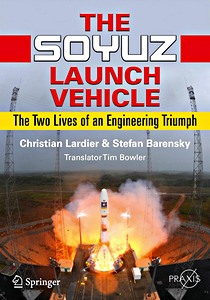
The Soyuz Launch Vehicle - the Two Lives of an Engineering Triumph

The Soyuz launch vehicle has had a long and illustrious history. Built as the world's first intercontinental missile, it took the first man into space in April 1961, before becoming the workhorse of Russian spaceflight, launching satellites, interplanetary probes, every cosmonaut from Gagarin onwards, and, now, the multinational crews of the International Space Station.

This remarkable book gives a complete and accurate description of the two lives of Soyuz, chronicling the cooperative space endeavor of Europe and Russia.
First, it takes us back to the early days of astronautics, when technology served politics. From archives found in the Soviet Union the authors describe the difficulty of designing a rocket in the immediate post-war period.
Then, in Soyuz's golden age, it launched numerous scientific missions and manned flights which were publicized worldwide while the many more numerous military missions were kept highly confidential!

The second part of the book tells the contemporary story of the second life of Soyuz, gathered from Western sources and interviews with key protagonists. It addresses the sensitive issue of the strategic choices that led to the establishment of Soyuz in French Guiana, describing the role of a few visionaries in Russia and in Europe who decided to leave their respective isolation behind and bring Syouz and Ariane together.

Detalle del libro

Autor:Christian Lardier, Stefan Barensky
Presentación:512 páginas, 24 x 17 x 1.9 cm, tapa blanda
Ilustración:122 fotos en b/n y 111 a color
Idioma:Inglés
Editorial:Springer-Verlag New York Inc. (USA, 2013)
ISBN:9781461454588
Portada del libro: The Soyuz Launch Vehicle - the Two Lives of an Engineering Triumph | Springer (USA)

The Soyuz Launch Vehicle - the Two Lives of an Engineering Triumph

Idioma: Inglés
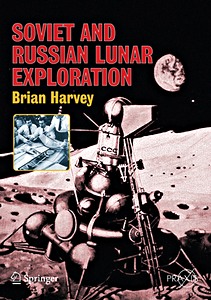
Soviet and Russian Lunar Exploration

Little is known of Soviet and Russian lunar exploration although, in fact, the Soviet Union/Russia:
- Sent the first spaceships past the moon, the first to hit the moon and the first to circle the moon
- Was first to soft land on and orbit the moon
- Was first to send a spaceship around the moon and recover it on Earth
- Came very close to sending a cosmonaut around the moon first
- Built and successfully tested, in Earth orbit, a lunar lander
- Pioneered sophisticated, precise high-speed reentries into the Earth's atmosphere
- Came close to perfecting a giant moon rocket, the N-1
- Retrieved three sets of rock samples from the moon by automatic spacecraft
- Landed advanced roving laboratories that explored the moon for months on end, traveling 48km
- Designed long-term lunar bases.
These were remarkable achievements requiring a considerable level of engineering sophistication and have a place in the contemporary story of astronautics. Recent landings on Mars use, essentially, the very techniques developed by Russia to land on and explore the moon in the 1960s and 1970s.

As an acknowledged expert and author of several books on the Soviet and Russian space programme, Brian Harvey is ideally suited to cover not only the engineering and scientific side but also the human stories of the Soviet and Russian lunar programme. These include those of the cosmonaut squad that trained to land on the moon, but was stood down, and of the designers who tried to realise the dream of a Russian moon, from Tikhonravov to Mishin: a Soviet lunar programme was first proposed by designer Mikhail Tikhonravov in a children's magazine in 1951 and he persuaded a sceptical Soviet leadership of the value of a moon programme.
Following Sputnik, the first lunar flights quickly achieved the key goals of hitting, circling and photographing the moon in 1959. The Soviet Union achieved all the early 'firsts' in lunar exploration, such as soft landing and orbiting the moon, and Brian Harvey will recount the frantic efforts to rival America's Apollo and the dramatic hours of 21st July 1969, when Russia tried to soft land Luna 15 in the Sea of Crises even as Armstrong and Aldrin explored the moon in the nearby Sea of Tranquility.

Contents: Origins of the Soviet lunar programme - The first moon probes - Planning the lunar landing - The sof - landers and orbiters - The first cosmonauts to the moon - Around the moon - Samplers, rovers and orbiters - Return to the moon - List of all Soviet moon probes (and related missions) - Bibliographical note and bibliography.

Detalle del libro

Autor:Brian Harvey, David J. Shayler
Presentación:340 páginas, 24.5 x 17 x 1.8 cm, tapa blanda
Ilustración:124 ilustraciones b/n
Idioma:Inglés
Editorial:Springer-Verlag New York Inc. (USA, 2006)
ISBN:9780387218960
Portada del libro: Soviet and Russian Lunar Exploration | Springer (USA)

Soviet and Russian Lunar Exploration

Idioma: Inglés

Energiya-Buran : The Soviet Space Shuttle

This absorbing book describes the long development of the Soviet space shuttle system, its infrastructure and the space agency's plans to follow up the first historic unmanned mission.
The book includes comparisons with the American shuttle system and offers accounts of the Soviet test pilots chosen for training to fly the system, and the operational, political and engineering problems that finally sealed the fate of Buran and ultimately of NASA's Shuttle fleet.

Detalle del libro

Autor:Bart Hendrickx, Bert Vis
Presentación:552 páginas, 24 x 17 x 2.9 cm, tapa blanda
Ilustración:170 fotos en b/n
Idioma:Inglés
Editorial:Springer-Verlag New York Inc. (USA, 2007)
ISBN:9780387698489
Portada del libro: Energiya-Buran : The Soviet Space Shuttle | Springer (USA)

Energiya-Buran : The Soviet Space Shuttle

Idioma: Inglés

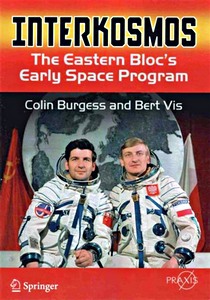
Interkosmos : The Eastern Bloc's Early Space Program

This book focuses on the Interkosmos program, which was formed in 1967, marking a fundamentally new era of cooperation by socialist countries, led by the Soviet Union, in the study and exploration of space.
The chapters shed light on the space program that was at that time a prime outlet for the Soviet Union's aims at becoming a world power. Interkosmos was a highly publicized Russian space program that rapidly became a significant propaganda tool for the Soviet Union in the waning years of communism.

Billed as an international "research-cosmonaut" imperative, it was also a high-profile means of displaying solidarity with the nine participating Eastern bloc countries. Those countries contributed pilots who were trained in Moscow for week-long "guest" missions on orbiting Salyut stations. They did a little subsidiary science and were permitted only the most basic mechanical maneuvers.

In this enthralling book, and following extensive international research, the authors fully explore the background, accomplishments and political legacy of the Interkosmos program.
Through personal and often highly revealing interviews with many of the participants they relate the very human story behind this extraordinary but controversial space venture.

Detalle del libro

Autor:Bert Vis, Colin Burgess
Presentación:321 páginas, 24.5 x 17.5 x 1.4 cm, tapa blanda
Ilustración:110 fotos en b/n y 147 a color
Idioma:Inglés
Editorial:Springer International Publishing AG (CH, 2015)
ISBN:9783319241616
Portada del libro: Interkosmos : The Eastern Bloc's Early Space Program | Springer

Interkosmos : The Eastern Bloc's Early Space Program

Idioma: Inglés

Russian Space Probes - Scientific Discoveries and Future Missions

The Soviet Union began the exploration of space with the launch of Sputnik in 1957, well over 50 years ago, and sent the first probes to the moon, Mars, and Venus. Less well known is what these probes actually found out. What were the discoveries of Russian space science? What new discoveries may we expect in the future? Who were Russia's most important scientists?

Russian Space Probes gives for the first time the definitive history of Soviet-Russian space science, and is the first book to assess the actual achievements of the Russian space program in furthering our knowledge of the Solar System.

Among other projects covered are missions such as Elektron, which mapped the Earth's radiation belts; the astrophysical observatories Astron, Kuant, Gamma, and Granat; Proton, which trapped cosmic rays; Prognoz, which measured solar radiation; and the Interball, Aktivny, APEX and Magion missions in which satellites chased each other in the Earth's magnetic tail.

The final part of the book examines the future of Russian space science and looks at planned new missions, such as the Spektr series of space observatories, and return flights to the moon and Mars, including sampling of Phobos.

Contents:
1. Early space science
2. Deepening our understanding
3. Revealing the Moon
4. Unveiling Venus
5. The path to Mars
6. Orbiting space stations
7. Later Soviet space science: the observatories
8. Perspectives, past and future

Annexe: Summary of Soviet and Russian space science missions
Bibliography
Index

Detalle del libro

Autor:Brian Harvey, Olga Zakutnyaya
Presentación:514 páginas, 24 x 17 cm, tapa blanda
Ilustración:149 fotos en b/n
Idioma:Inglés
Editorial:Springer-Verlag New York Inc. (USA, 2011)
ISBN:9781441981493
Portada del libro: Russian Space Probes - Scientific Discoveries and Future Missions | Springer (USA)

Russian Space Probes - Scientific Discoveries and Future Missions

Idioma: Inglés

Russian Space Suits

A unique contribution to space science. The authors, part of the original Zveda team that manufactured spacesuits for the first Russian space flights, still play an integral role in spacesuit research and development. Thus there is no-one better to describe the technical innovations of the past 40 years, which enabled Gagarin's first flight in 1961, the first space walk in 1965 and the Mir missions of the 1980s and 1990s, and which have culminated in today¹s International Space Station.

The authors also describe how the political climate within the Soviet Union and internationally has affected the development of the space programme and their work.
Many documents are published for the first time that, together with photographs, detailed descriptions of the events of the time and the authors' personal memories, provide a fascinating review of a previously unknown aspect of space science.

Contents:
- Introduction and background
- How full pressure spacesuits came about. Time period preceding the space mission era
- The Vostok era
- Spacesuit and equipment for the world's first EVA
- EVA suit for the Soyuz-4 and Soyuz-5 missions
- Spacesuits for the Soviet Moon programme
- SOKOL-K and SOKOL-KV-2 rescue suits for Soyuz
- Orbit-based spacesuits of the ORLAN type
- Equipment for the Cosmonaut Transference and Manoeuvring Unit (UPMK)
- Buran reusable space system
- Evolution of the European EVA spacesuit
- Human physiological aspects in designing the EVA spacesuit
- Potential projects on planetary suits for the Moon and Mars
- Who's who in Soviet/Russian spacesuit technology
- Russian spacesuit artefacts.

Detalle del libro

Autor:Isaak P. Abramov, As. Ingemar Skoog
Presentación:400 páginas, 24.5 x 17 cm, tapa blanda
Ilustración:ilustrado
Idioma:Inglés
Editorial:Springer London Ltd (GB, 2003)
ISBN:9781852337322
Portada del libro: Russian Space Suits | Springer (GB)

Russian Space Suits

Idioma: Inglés

Salyut - The First Space Station - Triumph and Tragedy

This remarkable book offers a unique insight into the people involved in the development of the Salyut space station and the crews assigned to operate it. It describes the rotation between the crews, analyses the decision to send the back-up crew on Soyuz 11 and recounts the intrigues and difficult relationships between all the personalities involved - politicians, CKBEM managers, designers, generals and cosmonauts.
Biographies of the Soyuz 11 cosmonauts are published for the first time in English and the longest manned space mission of the time is described before Grujica Ivanovich gives a unique summary of the most tragic day in the Soviet / Russian manned space program. An investigation into the cause of the tragic deaths of the Soyuz 11 cosmonauts precedes a description of the post-Salyut era, showing how the legacy of the first space station has survived for decades.

Contents: From Almaz to Salyut - DO -1 crews - Salyut in space - The drama of the Granites - Mutiny at the cosmodrome - Dobrovolskiy, Volkov and Patsayev - Home in orbit - Science and conflicts - The fire - Drawing away from the station - Cosmonauts dead on landing - Farewell - Thirteen seconds to eternity - The fall of the Chief Designer - Memories.

Detalle del libro

Autor:Grujica S. Ivanovich
Presentación:454 páginas, 24.5 x 17 x 2.8 cm, tapa blanda
Ilustración:103 ilustraciones b/n
Idioma:Inglés
Editorial:Springer-Verlag New York Inc. (USA, 2008)
ISBN:9780387735856
Portada del libro: Salyut - The First Space Station - Triumph and Tragedy | Springer (USA)

Salyut - The First Space Station - Triumph and Tragedy

Idioma: Inglés

Soyuz - A Universal Spacecraft

In "Soyuz: A Universal Spacecraft", authors Rex Hall and Dave Shayler review the development and operations of the Soyuz family of spacecraft. This includes the lesser-known military and unmanned versions of this reliable spacecraft.
While most works on Soviet / Russian space operations focus on space station activities, the story of the Soyuz spacecraft has been largely neglected. An integral element of Salyut and Mir space station operations, the small ferry has been the mainstay of cosmonaut transportation since 1967. In addition, since 1978 the unmanned freighter version called Progress has provided a means in which to regularly re-supply a space station and so prolong its orbital lifetime.
Using authentic Soviet and Russian sources this book is the first known work in the west dedicated to revealing the full story of the Soyuz series, including a complete listing of vehicle production numbers.

Contents: Foreword - Author's Introduction - Preface: Into Space on Soyuz - Origins - Early Soyuz - First Flights - The Lunar Adventure - Return to Flight - Soyuz to Salyut - Solo Soyuz - Person Upgrade - Space Freighter - Soyuz for ISS - Cosmonaut Training - Unmanned Applications - Appendices - Glossary - References - Bibliography - Index.

Detalle del libro

Autor:Rex Hall, David Shayler
Presentación:459 páginas, 25 x 18 x 2.6 cm, tapa blanda
Ilustración:ilustrado
Idioma:Inglés
Editorial:Springer London Ltd (GB, 2003)
ISBN:9781852336578
Portada del libro: Soyuz - A Universal Spacecraft | Springer (GB)

Soyuz - A Universal Spacecraft

Idioma: Inglés

The First Soviet Cosmonaut Team - Their lives, legacy, and historical impact

During the first months of 1960, with the United States and the USSR engaged in plans to launch the first manned spacecraft, twenty young Soviet Air Force officers reported for duty at a top secret training facility just outside Moscow. From among these cosmonaut candidates would emerge the first person to fly into space - Yuri Gagarin.

Eventually twelve of these cosmonauts realized their dream of flying missions into space, but the other eight fell by the wayside. A quarter of a century would pass before the world learned the identities of these eight men, whose names were kept a closely guarded secret and were bypassed in spaceflight history.

Now, for the first time, the full facts and biographical details are revealed for all twenty Soviet pilots in that first cosmonaut group - men given the unparalleled chance to create history, but who lived (and sometimes died) in a State-enforced Cold War anonymity.

Contents: Foreword by Alexei Leonov - Authors' preface - About the authors - Acknowledgements - List of figures - List of abbreviations and acronyms - Sparking the Space Age - A few good Soviet men - Russia 's future spacemen - Training days - Selecting the first cosmonaut - "Poyekhali!": A man in space - Vostok flights continue - The "missing" cosmonauts: Rumour and reality - First woman of space - A tragedy, and Gagarin 's final flight - Pushing the limits - Orbits of co-operation and the end of an era.

Appendices: A Biographies in brief - B Final cosmonaut candidates - C The first cosmonaut team (TsPK-1) - D Guide to flight and programme assignments - E Parachute jumps completed by Valentin Filatyev, 1960 - 1963 - F Space flights by Group 1 cosmonauts - G Cumulative time in space - H Highest honour: Hero of the Soviet Union - Index.

Detalle del libro

Autor:Colin Burgess, Rex Hall
Presentación:400 páginas, 24.5 x 17 cm, tapa blanda
Ilustración:170 fotos en b/n
Idioma:Inglés
Editorial:Springer-Verlag New York Inc. (USA, 2008)
ISBN:9780387848235
Portada del libro: The First Soviet Cosmonaut Team - Their lives, legacy, and historical impact | Springer (USA)

The First Soviet Cosmonaut Team - Their lives, legacy, and historical impact

Idioma: Inglés

The Rocket Men : Vostok and Voskhod, the First Soviet Manned Spaceflights

In four short years from 1961, the first manned orbiting space vehicle ­ Vostok ­ went into orbit, the first spacecraft piloted by a woman was launched, and the first man stepped outside his orbiting spaceship. All these milestone events were achieved by the USSR.
At the height of the Cold War in the early 1960s, the USSR dominated the 'space race' that would ultimately become a race to land a man on the Moon.

How did the Soviet Union get such a head-start on the USA? In The Rocket Men, Rex Hall and David Shayler chronicle the rise of the Soviet space program, from its early beginnings to the development of the huge launch complex that is still in use today.
This detailed yet highly readable book draws on recently released archive information and features photographs, from people who lived and worked in Star City, never before seen in the West.

Here is the definitive book about a time when Russia was supreme in space!

Contents:
- First dreams, theories and pioneers
- First launcher, pad and satellites
- First spacecraft and first cosmonauts
- First man and first day
- First group flights and first woman
- First crew and first EVA
- The legacy
- Conclusion
- Appendix

Detalle del libro

Autor:Rex Hall, David Shayler
Presentación:358 páginas, 23.5 x 15.5 cm, tapa blanda
Ilustración:ilustrado
Idioma:Inglés
Editorial:Springer London Ltd (GB, 2001)
ISBN:9781852333911
Portada del libro: The Rocket Men : Vostok and Voskhod, the First Soviet Manned Spaceflights | Springer (GB)

The Rocket Men : Vostok and Voskhod, the First Soviet Manned Spaceflights

Idioma: Inglés

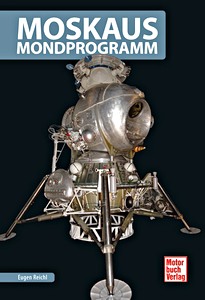
Moskaus Mondprogramm (Raumfahrt-Bibliothek)

The Soviet plans to reach the moon were ultimately the starting signal for the competition between the two superpowers for supremacy in space. Soviet probes reached the moon with much media attention.
The USSR attempted to complete the rest of the program in complete secrecy, so that it could then announce the manned landing with a bang.

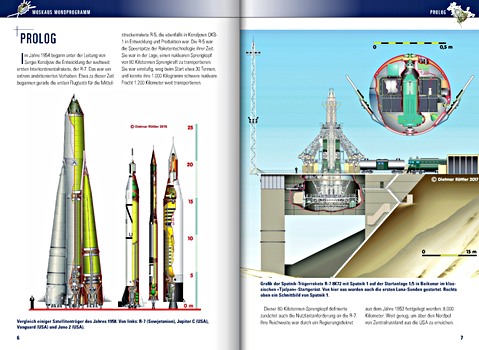
Páginas del libro Moskaus Mondprogramm (1)

Páginas del libro "Moskaus Mondprogramm"

The fact that this did not succeed is history. But the exciting path to it, the daring attempts and spectacular failures - only a few people know about it. Eugen Reichl sheds light on the USSR's path to the moon with the help of exciting information and pictures. A must for every space enthusiast!

Detalle del libro

Autor:Eugen Reichl
Presentación:144 páginas, 20.5 x 14 cm, tapa blanda
Ilustración:17 fotos en b/n y 73 a color
Idioma:Alemán
Editorial:Motorbuch Verlag (D, 2017)
Colección:Raumfahrt-Bibliothek
ISBN:9783613040274
Portada del libro: Moskaus Mondprogramm | Raumfahrt-Bibliothek | Motorbuch

Moskaus Mondprogramm

Idioma: Alemán

Projekt Sputnik - Der Aufbruch ins All (Raumfahrt-Bibliothek)

"Sputnik" was the name of the first satellite that was successfully launched into Earth orbit; it was followed by nine more satellites of the same name.
On October 4 1957, the Soviet Union launched the spherical Sputnik 1 from the Baikonur Cosmodrome. The launch sent the Western world into a panic, because it put the Soviet Union ahead in the race for supremacy in space.
An exciting piece of contemporary and technical history. Eberhardt Rödel is a specialist in the history of Russian space travel.

Detalle del libro

Autor:Eberhard Rödel
Presentación:128 páginas, 20.5 x 14 cm, tapa blanda
Ilustración:140 fotos en b/n y color
Idioma:Alemán
Editorial:Motorbuch Verlag (D, 2014)
Colección:Raumfahrt-Bibliothek
ISBN:9783613037199
Portada del libro: Projekt Sputnik - Der Aufbruch ins All | Raumfahrt-Bibliothek | Motorbuch

Projekt Sputnik - Der Aufbruch ins All

Idioma: Alemán

También te puede interesar:

Portada del libro: De la terre à la lune - La conquête spatiale américaine de Mercury à Apollo

De la terre à la lune - La conquête spatiale américaine de Mercury à Apollo

Antony Angrand | Francés | tapa dura | 368 pág. | 2010

Portada del libro: NASA - Space Flight Research and Pioneering Developments

NASA - Space Flight Research and Pioneering Developments

Hans-Jürgen Becker | Inglés | tapa dura | 200 pág. | 2012

Portada del libro: SpaceX's Dragon : America's Next Generation Spacecraft

SpaceX's Dragon : America's Next Generation Spacecraft

Erik Seedhouse | Inglés | tapa blanda | 188 pág. | 2015

Portada del libro: The Birth of NASA : The Work of the Space Task Group, America's First True Space Pioneers

The Birth of NASA : The Work of the Space Task Group, America's First True Space Pioneers

Manfred 'Dutch' von Ehrenfried | Inglés | tapa blanda | 358 pág. | 2016

Portada del libro: U. S. Spacesuits (2nd Edition)

U. S. Spacesuits (2nd Edition)

Kenneth S. Thomas, Harold J. McMann | Inglés | tapa blanda | 512 pág. | 2011

Portada del libro: Die Zukunft der Raumfahrt - Private Projekte

Die Zukunft der Raumfahrt - Private Projekte

Eugen Reichl | Alemán | tapa dura | 144 pág. | 2022