Acquistando tramite i link, sostieni nostro sito senza alcun costo aggiuntivo per te. Per saperne di più >

Semoventi - USA: libri - storia e modelli

Un libro sui semoventi? Scoprite qui i volumi illustrati sulla storia, i modelli e la tecnologia dei semoventi degli USA.

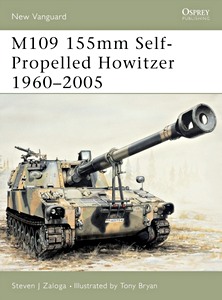
M109 155mm Self-propelled Howitzer 1960-2005 (Osprey)

Entering service in the early 1960s, the M109 Self-Propelled Howitzer has been in production for 34 years and forms the backbone of US Army and Reserve artillery units. The M109A6 is the latest development of the M109 series and incorporates advanced fire control systems that enable it to have its first rounds on target less than 60 seconds after arriving at firing location. This ability to shift quickly between moving and firing modes avoids counter battery fire and ensures battlefield survivability.

This book details an impressive and versatile weapon that has served around the globe in Southeast Asia and in Operations Desert Shield and Desert Storm.

Contents: Introduction - Cold War Origins - First combat: Vietnam - Long range firepower - Enhancing lethality - Mid-east combat - Precision guided munitions - The modernization dilemma - Feeding the guns - Operation Desert Storm - Operation Iraqi Freedom - Internation Programs - Bibliography - Color plate commentary - Index.

Dettagli del libro

Autore:Steven J. Zaloga
Formato:48 pagine, 25 x 18.5 x 0.4 cm, brossura
Illustrazioni:riccamente illustrato con foto e disegni (in B&N e in colori)
Lingua:inglese
Editore:Osprey Publishing (GB, 2005)
Collana:New Vanguard (86)
ISBN:9781841766317
Copertina del libro: M109 155mm Self-propelled Howitzer 1960-2005 | New Vanguard (86) | Osprey

M109 155mm Self-propelled Howitzer 1960-2005

Lingua: inglese

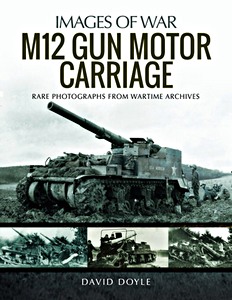
M12 Gun Motor Carriage - Rare Photographs from Wartime Archives (Images of War)

Although only 100 examples were produced, the 155mm Gun Motor Carriage M12 served with distinction as an infantry-support weapon and in particular as a bunker-buster during the U.S. assault on the Siegfried Line in the winter of 1944-45.

The ability to rapidly ready heavy artillery for firing lead to the development of the M12 155mm gun in 1941, based on the M3 Medium Tank chassis. The trial vehicle, built by Rock Island Arsenal, was designated T6.
To accommodate the large, rear mounted weapon - a French-made M1917 155mm gun, the engine was relocated forward to a position just behind the driving compartment. A hydraulically operated spade mounted at the rear of the vehicle, which was lowered during firing to anchor the vehicle against the recoil. When retracted into the travelling position it provided a seat for two of the six crewmen.

The production run was between September 1942 and March 1943, with a total of one hundred units being built. Though a few were used by training units, most were placed in storage until February 1944, when the first of 74 of them were shipped to Baldwin Locomotive Works to be improved based on further tests and usage in training. This work continued until May 1944.

Three slightly different WWI surplus weapons were mounted depending upon availability, the M1917, the M1917A1 and the M1918M1. The M1917 was French built, the M1918 was US built, and the M1917A1 had the French gun tube, and the US breech.

Dettagli del libro

Autore:David Doyle
Formato:152 pagine, 24.5 x 19 x 1.2 cm, brossura
Illustrazioni:194 foto in B&N e in colori
Lingua:inglese
Editore:Pen & Sword Books Ltd (GB, 2018)
Collana:Images of War
ISBN:9781526743527
Copertina del libro: M12 Gun Motor Carriage - Rare Photographs from Wartime Archives | Images of War | Pen & Sword

M12 Gun Motor Carriage - Rare Photographs from Wartime Archives

Lingua: inglese

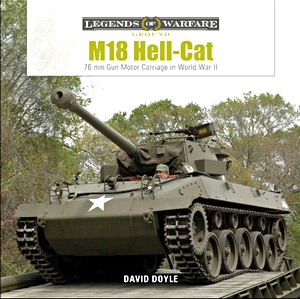
M18 Hell-Cat - 76 mm Gun Motor Carriage in World War II (Legends of Warfare)

The M18 was developed in an era when the United States fought tanks not with other tanks, but with specialized tank destroyers. With a powerful aircraft-style radial engine pushing it at up to 50 miles per hour, and mounting a potent 76 mm cannon, the Buick-built M18 Hellcat, or "Hell-Cat" as Buick's publicists named it, provided US troops with a powerful shoot-and-scoot answer to heavily armored German tanks. Further experiments were conducted to increase its armament or adapt it to other uses, such as the M39 armored utility vehicle.

Through dozens of archival images, many never before published, as well as detailed photographs of some of the finest existent examples of these vehicles, this iconic tank hunter is explored, and its history is explained. Part of the Legends of Warfare series.

Dettagli del libro

Autore:David Doyle
Formato:112 pagine, 23.5 x 23.5 x 1.9 cm, copertina rigida
Illustrazioni:160 foto in B&N e in colori
Lingua:inglese
Editore:Schiffer Publishing Ltd (USA, 2020)
Collana:Legends of Warfare
ISBN:9780764359576
Copertina del libro: M18 Hell-Cat - 76 mm Gun Motor Carriage in World War II | Legends of Warfare | Schiffer

M18 Hell-Cat - 76 mm Gun Motor Carriage in World War II

Lingua: inglese

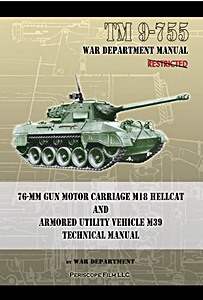
M18 Hellcat 76mm Gun Motor Carriage - Technical Manual (TM9-755)

The M18 Hellcat was an American tank destroyer during World War II. Armed with a 76-mm cannon, it was the fastest tracked armored fighting vehicle during World War II with a top speed up to sixty mph. As a result, Buick nicknamed it the Hellcat.
The fast speed was reached by keeping armor thickness to a minimum. Hellcat crews took advantage of the vehicle's speed to minimize the enemy's ability to pierce its thin armor.

The M18's new design incorporated several innovative maintenance features. The Wright R-975 engine was mounted on steel rollers, allowing maintenance crews to disconnect it easily from the transmission, roll it out onto the lowered engine rear cover, service it, and then reconnect it again. The transmission could also easily be removed and rolled out onto a front deck plate to enable quick inspection and repairs.

The M18 carried a five man crew as well as forty five rounds of main gun ammunition, and an M2 Browning machine gun on a flexible ring mount for use against aircraft and infantry. The only M18 variant which was produced in significant numbers was the M39 Armored Utility Vehicle, a turretless model used to transport personnel or cargo. Also, it could be used as a gun tractor. This version was armed with a single M2 machine gun on a flexible mount.

Created in 1945, this technical manual reveals a great deal about the Hellcat's design and capabilities. Intended as a manual for those charged with operation and maintenance, it details many aspects of its engine, cooling, turret and other systems.
Originally labeled restricted, this manual was declassified long ago and is here reprinted in book form. Care has been taken to preserve the integrity of the text.

Dettagli del libro

Autore:U.S. Army War Department
Formato:540 pagine, 23 x 15.5 x 3.1 cm, brossura
Illustrazioni:riccamente illustrato con foto e disegni
Lingua:inglese
Editore:Periscope Film (USA, 2013)
ISBN:9781937684464
Copertina del libro: M18 Hellcat 76mm Gun Motor Carriage - Technical Manual (TM9-755) | Periscope

M18 Hellcat 76mm Gun Motor Carriage - Technical Manual (TM9-755)

Lingua: inglese

M7 Priest : Rare Photographs from Wartime Archives (Images of War)

The M7 Howitzer Motor Carriage, dubbed the Priest, was the most successful and widely used example of American self-propelled artillery during WWII. Examples continued to be used by the U.S. Army during the Korean war, and beyond, even serving Allied countries into the 1970s.
Coined the Priest due to its pulpit-like structure for the gun commander, this armored fighting vehicle would see action in North Africa, Italy, and the D-Day landings in Normandy and all the way to Germany.

Dettagli del libro

Autore:David Doyle
Formato:144 pagine, 24.5 x 19 cm, brossura
Illustrazioni:190 foto in B&N e 20 in colori
Lingua:inglese
Editore:Pen & Sword Books Ltd (GB, 2019)
Collana:Images of War
ISBN:9781526738851
Copertina del libro: M7 Priest : Rare Photographs from Wartime Archives | Images of War | Pen & Sword

M7 Priest : Rare Photographs from Wartime Archives

Lingua: inglese

M7 Priest 105mm Howitzer Motor Carriage (Osprey)

Based upon the ubiquitous Grant/Sherman tank, the M7 Priest is the iconic Allied self-propelled howitzer. It was the most widely manufactured vehicle of its type in World War ll and was utilized by the US, British, Canadian and Free French forces. Its combat debut was with Montgomery's Eight Army at El Alamein and it fought subsequently in every major campaign through Sicily, Italy, Normandy and the final battles in Germany.
In addition to covering all variants of the Priest, this book also looks at the major derivatives, including the British/Canadian Sexton and the US M12 155mm GMC.

Contents: Introduction - Design & Development - Operational History - Variants - Bibliography - Index.

Dettagli del libro

Autore:Steven J. Zaloga
Formato:48 pagine, 24.5 x 18.5 x 0.4 cm, brossura
Illustrazioni:riccamente illustrato con foto e disegni (in B&N e in colori)
Lingua:inglese
Editore:Osprey Publishing (GB, 2013)
Collana:New Vanguard (201)
ISBN:9781780960234
Copertina del libro: M7 Priest 105mm Howitzer Motor Carriage | New Vanguard (201) | Osprey

M7 Priest 105mm Howitzer Motor Carriage

Lingua: inglese

155-mm Gun Motor Carriage M12 and Cargo Carrier M30 - Technical Manual (TM9-751)

The 155-mm Gun Motor Carriage M12 was a U.S. self-propelled gun developed during the Second World War. Only 100 were built; sixty in 1942 and another forty in 1943.
The M12 was built on the chassis of the M3 Lee tank. It had an armored driver's compartment, but the gun crew were located in an open topped area at the back of the vehicle. An earth spade at the rear was employed to absorb recoil.

During 1943 the vehicles were used for training or put into storage. Before the invasion of France, seventy four M12s were upgraded in preparation for combat operations. They were employed successfully throughout the campaign in North-West Europe. Although designed primarily for indirect fire, during assaults on heavy fortifications the M12s were sometimes employed in a direct-fire role.
Limited storage space meant that only ten projectiles and propellant charges could be carried on the vehicle. Given this, a similar vehicle without the gun was produced as the Cargo Carrier M30. This was designed to transport the gun crew and additional ammunition.
In operational conditions the M12 and M30 would serve in pairs. The M30, which could carry forty rounds of 155-mm ammunition, was armed with a .50-caliber Browning M2 machine gun.

Created in 1944, this technical manual reveals a great deal about the M12's and M30's design and capabilities. Intended as a manual for those charged with operation and maintenance, it details many aspects of the M12's engine, cooling, power, suspension and other systems.
Originally labeled restricted, this manual was declassified long ago and is here reprinted in book form. Please note, this text was not produced in large numbers and this replica may have some pages that are substandard in quality. Care has been taken however to preserve the integrity of the text.

Dettagli del libro

Autore:U.S. Army War Department
Formato:326 pagine, 23 x 15 cm, brossura
Illustrazioni:riccamente illustrato con foto e disegni
Lingua:inglese
Editore:Periscope Film (USA, 2013)
ISBN:9781937684396
Copertina del libro: 155-mm Gun Motor Carriage M12 and Cargo Carrier M30 - Technical Manual (TM9-751) | Periscope

155-mm Gun Motor Carriage M12 and Cargo Carrier M30 - Technical Manual (TM9-751)

Lingua: inglese

M10 / Achilles - A Visual History of the U.S. Army's WWII Tank Destroyer

In late 1941 the concept of a separate tank destroyer force began to jell. This force would be armed with specialized weapons. While the army's primary antitank weapons of the late 1930s were 37mm towed anti-tank guns, these were soon deemed to be inadequate against enemy armor. Accordingly, the quest for larger weapons began, as did the desire for a self-propelled antitank gun, or Gun Motor Carriage.
The initial efforts, which involved adapting ¾-ton, Dodge trucks to mount antitank weapons (the M6, née WC-55), which were intended as interim and training vehicles. In the same manner, half-tracks were fitted with cannon, yielding the M3 75mm Gun Motor Carriage. But, the quest was on to create a specialized and ideal tank destroyer, utilizing a tank chassis as the basis.

By January of 1942 a prototype was in the works to mount the weapon in an open topped turret on the chassis of the twin GM Diesel-powered M4A2 Sherman Medium tank.
After some months of development a design was finalized for a vehicle sharing the suspension, lower hull, and engine with the M4A2 but with an upper hull made up from thinner, but sloping, armored plate. Initially designated T35E1, when the design was standardized it was redesignated M10. In addition to the 6,700-plus Diesel-powered M10 tank destroyers, a further 1,700 M10A1 vehicles were built, these being driven by Ford GAA gasoline engines.

While the 3-inch weapon of the M10 was superior to that found on earlier U.S. tank destroyers, it was inadequate against the ever-increasing weight of German armor. The British addressed this by rearming some of the 1,700 M10s that they received with the superb Ordnance Quick Firing 17-pounder antitank gun. These vehicles were designated by the British as 17-pdr. SP M10 Mark 1c. After the war the name Achilles was given these vehicles.

Photo coverage includes plentiful period shots and copious amounts of detail photos of the M10, M10A1 and Achilles.

Dettagli del libro

Autore:David Doyle
Formato:128 pagine, 22.5 x 29 cm, brossura
Illustrazioni:riccamente illustrato con foto in B&N e in colori
Lingua:inglese
Editore:Ampersand Publishing Company, Inc. (USA, 2016)
ISBN:9781944367190
Copertina del libro: M10 / Achilles - A Visual History of the U.S. Army's WWII Tank Destroyer | Ampersand

M10 / Achilles - A Visual History of the U.S. Army's WWII Tank Destroyer

Lingua: inglese

M10 and M36 Tank Destroyers 1942-1953 (Osprey)

The US Army had a unique tactical doctrine during World War II, placing the emphasis for tank fighting on its Tank Destroyer Command whose main early-war vehicle was the M10 3-inch Gun Motor Carriage, based on the reliable M4A2 Sherman tank chassis. This durable and versatile vehicle saw combat service from the North Africa campaign in 1943. By 1944, its gun was not powerful enough and it was rearmed with the new 90 mm gun, becoming the M36 90mm Gun Motor Carriage.

This book details one of the only US armoured vehicles capable of dealing with the Panther and Tiger during the Battle of the Bulge.

Contents: Introduction - Tank destroyer origins - Initial production - Into service - Production changes - Combat in France - Tank destroyers in the Pacific - The M10 in British service - Other Lend-Lease use - Postwar use - Bibliography - Color Plate Commentary - Index.

Dettagli del libro

Autore:Steven J. Zaloga
Formato:48 pagine, 25 x 18 x 0.5 cm, brossura
Illustrazioni:riccamente illustrato con foto e disegni (in B&N e in colori)
Lingua:inglese
Editore:Osprey Publishing (GB, 2002)
Collana:New Vanguard (57)
ISBN:9781841764696
Copertina del libro: M10 and M36 Tank Destroyers 1942-1953 | New Vanguard (57) | Osprey

M10 and M36 Tank Destroyers 1942-1953

Lingua: inglese

M10 Gun Motor Carriage: and the 17-Pounder Achilles Tank Destroyer (Legends of Warfare)

Based on the M4A2 and M4A3 Sherman tank chassis, and fitted with a 3-inch M7 gun, the M10 was numerically the most important US tank destroyer of WWII. The M10 was built in response to the stunning successes of the German armored Blitzkrieg at the outset of the war in Europe.
Fitted with a turret - unlike most self-propelled artillery of the era - the vehicle was more heavily gunned but more lightly armored than a tank. M10 crews were expected to make the most of their vehicle's speed and agility.

Pagine del libro M10 Gun Motor Carriage: and the 17-Pounder Achilles (1)

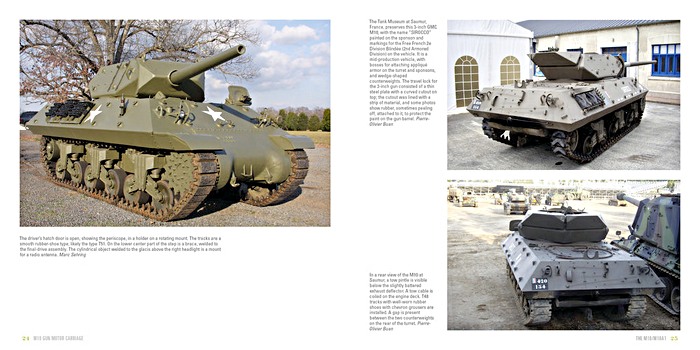
Pagine del libro "M10 Gun Motor Carriage: and the 17-Pounder Achilles Tank Destroyer"

The M10 received its baptism of fire in Tunisia in 1943, where it demonstrated its ability to destroy most German Panzers then in service. The British upgraded the design by rearming some of the 1,700 M10s that they received with the superb Ordnance Quick Firing 17-pounder antitank gun.
These vehicles were designated by the British as 17-pounder SP M10 Mark IC/IIC, popularly known as the Achilles.

Dettagli del libro

Autore:David Doyle
Formato:144 pagine, 23.5 x 23.5 x 2.1 cm, copertina rigida
Illustrazioni:260 foto in B&N e in colori
Lingua:inglese
Editore:Schiffer Publishing Ltd (USA, 2022)
Collana:Legends of Warfare
ISBN:9780764364860
Copertina del libro: M10 Gun Motor Carriage: and the 17-Pounder Achilles Tank Destroyer | Legends of Warfare | Schiffer

M10 Gun Motor Carriage: and the 17-Pounder Achilles Tank Destroyer

Lingua: inglese

M10 Tank Destroyer vs StuG III Assault Gun - Germany, 1944 (Osprey)

The Allies' M10 Tank Destroyer and the Germans' Sturmgeschütz (StuG) lll were the unsung workhorses of the northwest European battlefields of 1944-45. While their mission was not principally fighting one another, their widespread use ensured their frequent encounters, from the Normandy Bocage, to the rubble-strewn streets of Aachen.
The StuG lll was the quintessential assault gun, a low-slung, heavily armoured, turret-less vehicle intended to provide direct fire support for infantry formations, whilst the M10 3in Gun Motor Carriage was originally developed as a tank destroyer. However, by 1944 the 3in gun proved ineffectual against the most thickly armored German tanks, and was consequently relegated to infantry support too.
Widely deployed in roles their designers had not envisaged, these two armoured fighting vehicles clashed repeatedly during the 11-month campaign, which saw the Allies advance from Normandy to the heart of the Reich. Fully illustrated with specially commissioned artwork, this is the story of their confrontation at the height of World War ll.

Contents: Introduction - Chronology - Design and Development - Technical Specifications - The Combatants - The Strategic Situation - Combat - Statistics and Analysis - Further Reading - Index.

Dettagli del libro

Autore:Steven J. Zaloga
Formato:80 pagine, 24.5 x 19 x 0.7 cm, brossura
Illustrazioni:riccamente illustrato con foto e disegni (in B&N e in colori)
Lingua:inglese
Editore:Osprey Publishing (GB, 2013)
Collana:Duel (53)
ISBN:9781780960999
Copertina del libro: M10 Tank Destroyer vs StuG III Assault Gun - Germany, 1944 | Duel (53) | Osprey

M10 Tank Destroyer vs StuG III Assault Gun - Germany, 1944

Lingua: inglese

M107 / M110 - Family of Self-propelled Artillery 1956 -1991

This 124-page softbound volume is profusely illustrated with almost 250 photos, many of them in color, illustrating the history and US military service of this weapon system, from its advent in the early 1950s through the first Gulf War.
Widely used in Vietnam, where it had the longest range of any land-based artillery, the M107 and M110 series of vehicles, along with the M109, formed the backbone of US self-propelled artillery for decades, including the height of the Cold War.

Many of these images in this volume have never before been published, including numerous color images taken in Vietnam. Augmenting the vintage photos are carefully selected photos of preserved examples chosen to illustrate the details of the vehicles. All variants of the M107 and M110 are presented in this volume.

Dettagli del libro

Autore:David Doyle
Formato:127 pagine, 30 x 21 x 1.3 cm, brossura
Illustrazioni:250 foto in B&N e in colori
Lingua:inglese
Editore:AFV Modeller (GB, 2022)
ISBN:9781739751302
Copertina del libro: M107 / M110 - Family of Self-propelled Artillery 1956 -1991 | AFV Modeller

M107 / M110 - Family of Self-propelled Artillery 1956 -1991

Lingua: inglese

M18 Hellcat Tank Destroyer 1943-97 (Osprey)

The M18 76mm Gun Motor Carriage was developed for the US Army's Tank Destroyer Command. It was the only tank destroyer deployed during World War II actually based on their requirements for speed and firepower.

This book examines the development of this vehicle, the controversies over the need for high-speed tank destroyers, and its actual performance during World War II. Special emphasis is placed on examining its performance in its intended mission. Coverage also includes derivative vehicles of the M18 such as the M39 armored utility vehicle.

Contents: Introduction - Design and Development - Operation History - Variants - Color plate commentary.

Dettagli del libro

Autore:Steven J. Zaloga
Formato:48 pagine, 25 x 19 x 0.5 cm, brossura
Illustrazioni:riccamente illustrato con foto e disegni (in B&N e in colori)
Lingua:inglese
Editore:Osprey Publishing (GB, 2004)
Collana:New Vanguard (97)
ISBN:9781841766874
Copertina del libro: M18 Hellcat Tank Destroyer 1943-97 | New Vanguard (97) | Osprey

M18 Hellcat Tank Destroyer 1943-97

Lingua: inglese

M36 / M36 B1 Tank Destroyer - Rare Photographs from Wartime Archives (Images of War)

Going into WWII, the prevailing strategy of the US command was that tanks were not to be used to engage enemy tanks in combat. Rather, tanks were to be the armored spearhead to breach enemy positions. Enemy tanks were to be dealt with by specialized weapons, aptly named tank destroyers.

While the 3-inch weapon of the M10 was superior to that found on earlier US tank destroyers, it was still found to be inadequate against the ever-increasing weight of German armor. An even larger gun, the 90 mm M3, was placed in a new, bigger open-topped turret on 100 new hulls purpose built for this, and by remanufacturing M10 A1s, primarily from US-based training units. As the supply of these chassis was depleted, additional vehicles were created by converting Diesel-powered M10s, resulting in the M36B2.

The M36 B1 was built from the ground-up as a tank destroyer, using a hull based on that of the M4 A3 but featuring a standard M36 turret. Examination of rare surviving vehicles indicate that the M36 B1 hulls were manufactured expressly for this purpose, and were not merely M4 A3 hulls that were converted.
While US antitank doctrine changed, rendering all the tank destroyers obsolete post-WWII, many of these vehicles were supplied to other nations, and in fact some survived as combat vehicles into the 21st century.

Dettagli del libro

Autore:David Doyle
Formato:128 pagine, 24.5 x 19 x 1 cm, brossura
Illustrazioni:175 foto in B&N e in colori
Lingua:inglese
Editore:Pen & Sword Books Ltd (GB, 2019)
Collana:Images of War
ISBN:9781526748928
Copertina del libro: M36 / M36 B1 Tank Destroyer - Rare Photographs from Wartime Archives | Images of War | Pen & Sword

M36 / M36 B1 Tank Destroyer - Rare Photographs from Wartime Archives

Lingua: inglese

M50 / M50A1 Ontos: Self-Propelled Multiple 106 mm Recoilless Rifle (Legends of Warfare)

Designed to counter the threat of a massed Soviet armored assault, the M50 Ontos showed its merit in the jungles and streets of Vietnam. Ontos grew out of Project Vista, the secret study of possible improvements to NATO defenses. Project Vista identified the need for an inexpensive, heavily armed "something" to thwart waves of Soviet armor.
Armed with six powerful recoilless rifles, the diminutive M50 was given the name "Ontos," an Army mistranslation of Greek for "the Thing."

Initially, the Army felt that the Allis-Chalmers T165E1 (later standardized as the M50) was the thing to fill the recommendation of Project Vista. Ultimately, and after some controversy, the Army lost interest in the vehicle, but the United States Marine Corps believed in the vehicle, and in 1955 the M50 entered production.

While the Corps first used the Ontos in Santo Domingo in 1965, it would rise to fame in Vietnam, where the M50, as well as the modernized M50A1, saw considerable use as antipersonnel weapons and in perimeter defense. On the streets of Hue, Marines made considerable use of the Ontos, blasting open walls and using antipersonnel rounds to create faux smoke screens.
Over 270 photos, many in color, chronicle the development, production, combat use, and details of this famed vehicle and the men who used them.

Dettagli del libro

Autore:David Doyle
Formato:128 pagine, 21.5 x 24 x 2.8 cm, copertina rigida
Illustrazioni:270 foto in B&N e in colori
Lingua:inglese
Editore:Schiffer Publishing Ltd (USA, 2022)
Collana:Legends of Warfare
ISBN:9780764365126
Copertina del libro: M50 / M50A1 Ontos: Self-Propelled Multiple 106 mm Recoilless Rifle | Legends of Warfare | Schiffer

M50 / M50A1 Ontos: Self-Propelled Multiple 106 mm Recoilless Rifle

Lingua: inglese

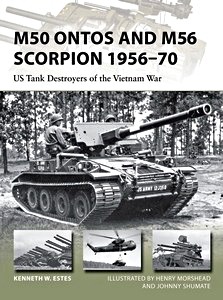
M50 Ontos and M56 Scorpion 1956-70 : US Tank Destroyers of the Vietnam War (Osprey)

Designed in the 1950s, the US Marines' M50 Ontos and the US Army's M56 Scorpion were both intended to be fast, light, air-droppable tank-killers for the Cold War battlefield - an answer to the cumbersome and ineffective World War II-vintage tanks that had taken to the battlefield during the Korean War.

Although they shared the aim of bringing light, mobile and lethal antitank firepower to the infantry the two vehicles varied wildly in design to cater for their unique mission demands. They first saw service in the Lebanon intervention of 1958 but it was in the Vietnam War that they made their name, with the M50 Ontos seeing intense combat action in the Battle of Hue in 1968.

Detailed illustrations and expert analysis provide the reader with a comprehensive history of these deadly antitank vehicles, from early development through to their combat history and the eventual disbandment of the Marine Corps' last antitank battalion with M50A1s in 1971.

Dettagli del libro

Autore:Kenneth W Estes
Formato:48 pagine, 25 x 18.5 x 0.5 cm, brossura
Illustrazioni:40 foto in B&N e 7 in colori
Lingua:inglese
Editore:Osprey Publishing (GB, 2016)
Collana:New Vanguard (240)
ISBN:9781472814739
Copertina del libro: M50 Ontos and M56 Scorpion 1956-70 : US Tank Destroyers of the Vietnam War | New Vanguard (240) | Osprey

M50 Ontos and M56 Scorpion 1956-70 : US Tank Destroyers of the Vietnam War

Lingua: inglese

Titoli correlati:

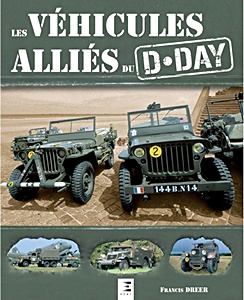
Copertina del libro: Les Véhicules Alliés du D-Day

Les Véhicules Alliés du D-Day

Francis Dreer | francese | copertina rigida | 192 p. | 2019

Copertina del libro: U.S. Army 1944 - Les marquages des véhicules 1944

U.S. Army 1944 - Les marquages des véhicules 1944

Jean Bouchery, Philippe Charbonnier | francese | brossura | 192 p. | 2018

Copertina del libro: Harley-Davidson WLA: The Main US Military Motorcycle of World War II | Legends of Warfare

Harley-Davidson WLA: The Main US Military Motorcycle of World War II

Robert S. Kim | inglese | copertina rigida | 112 p. | 2020

Copertina del libro: U.S. Vehicles and Heavy Weapons of the Vietnam War

U.S. Vehicles and Heavy Weapons of the Vietnam War

David Doyle | inglese | copertina rigida | 248 p. | 2021

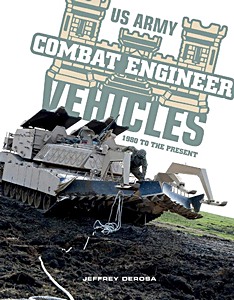
Copertina del libro: US Army Combat Engineer Vehicles (1980 to the Present)

US Army Combat Engineer Vehicles (1980 to the Present)

Jeffrey DeRosa | inglese | copertina rigida | 192 p. | 2021