Al comprar mediante los enlaces, apoyas este sitio sin coste adicional para usted. Más información >

Programa NASA Apolo - LEM: libros - historia y tecnología

¿Un libro sobre vuelos del Apolo a la luna? Aquí encontrarás los mejores libros sobre la tecnología del módulo de aterrizaje lunar LEM (Lunar Excursion Module).

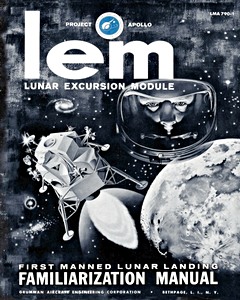
LEM - Lunar Excursion Module - First Manned Lunar Landing Familiarization Manual

Designed by Grumman's brilliant Tom Kelly, the Apollo Lunar Excursion Module (or "LEM" for short) was a triumph of purpose-built engineering. In the six years 1962-1968 between drawing board and first flight, a myriad of challenges were overcome related to weight, reliability and safety. The final design, designated the Lunar Module or "LM", boasted tiny windows instead of large portholes, four legs instead of five and most famously had no seats instead relying on the astronauts' legs to cushion a lunar landing.

Ten LMs made it into space including three flown in development and test missions, and six which landed on the Moon. A seventh famously saved the crew of Apollo 13 when that mission's Command Module suffered a catastrophic malfunction. Originally created for NASA by Grumman in 1964, this LEM Familiarization Manual provides an operational description of all subsystems and major components of the lunar lander. It includes sections about the LEM mission, spacecraft structure, operational subsystems, prelaunch operations, and ground support equipment.

Detalle del libro

Autor:Grumman Aircraft Engineering Co.
Presentación:164 páginas, 25.5 x 20.5 x 0.9 cm, tapa blanda
Ilustración:ricamente ilustrado con fotos y dibujos
Idioma:Inglés
Editorial:Periscope Film (USA, 2011)
ISBN:9781935700661
Portada del libro: LEM - Lunar Excursion Module - First Manned Lunar Landing Familiarization Manual | Periscope

LEM - Lunar Excursion Module - First Manned Lunar Landing Familiarization Manual

Idioma: Inglés

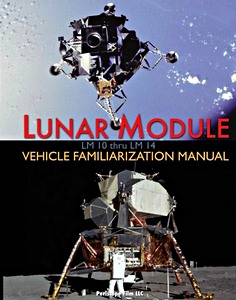
Lunar Module - LM 10 thru LM 14 - Vehicle Familiarization Manual

Originally created for NASA in 1969 by prime contractor Grumman, this Lunar Module Vehicle Familiarization Manual was mandatory reading for Apollo astronauts, contractors and NASA support staff.
This version of the manual describes the so-called ELM, or Extended Lunar Modules designed for the "J"class missions Apollo 15-17 and the never-flown Apollo 18 and 19.

The ELM came about as part of NASA's efforts to enhance the scientific study of the Moon and its geology. To do that, longer surface stays would be needed. To make it possible, LM 10 to LM 14 received various modifications intended to increase their payloads, and allow them to return larger samples to Earth.
Over forty major changes were planned, including enlarging the fuel and oxidizer tanks on both the ascent and descent stages, extension of the descent engine nozzle to improve its efficiency and allow it to deliver more power, and added capacity of oxygen and water.
Some changes,such as adding solar cells and affiliated batteries to allow surface stays of up to 72 hours, proved too difficult given the program's schedule.

In the end, the maximum duration of stays on the Moon would be limited to 54 hours. The extended LM weighed up to 36,500 pounds compared to 32,000 for earlier versions. The ELM's larger payload capacity enabled it to carry the 463 pound (mass) Lunar Roving Vehicle and other scientific equipment. The LRV greatly enhanced the astronauts' range and ability to retrieve samples.

It's never been easy to find a copy of this text because copies were never made available to the general public - until now. This reprint features all the original text and diagrams.

Detalle del libro

Autor:Grumman, NASA
Presentación:176 páginas, 25.5 x 20.5 x 0.9 cm, tapa blanda
Ilustración:ricamente ilustrado con fotos y dibujos
Idioma:Inglés
Editorial:Periscope Film (USA, 2013)
ISBN:9781937684631
Portada del libro: Lunar Module - LM 10 thru LM 14 - Vehicle Familiarization Manual | Periscope

Lunar Module - LM 10 thru LM 14 - Vehicle Familiarization Manual

Idioma: Inglés

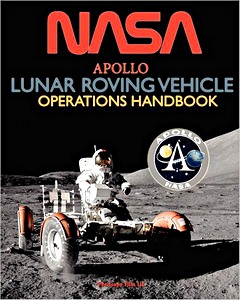
NASA Apollo - Lunar Roving Vehicle - Operations Handbook

Developed in only 17 months at a cost of 38 million dollars, the Lunar Roving Vehicle (LRV) greatly expanded the survey range of the astronauts on Apollo 15, 16 and 17. Designed to operate in the low-gravity vacuum of the Moon, the LRV boasted an ingenious design that allowed it to be folded up and stored inside the Lunar Module. It would then be deployed using a system of pulleys and brake reels.

For safety reasons, astronauts never drove the LRV a distance farther from the LM than they could safely walk in the unlikely event that the rover failed. On each of the three day missions that it was employed, the LRV was used daily for three traverses. The longest was on Apollo 17, when it was driven 20.1km, and it traveled a total of 35.9km on that mission.

The total distance traveled by all three LRVs was 90.4km. Almost all of it was done without incident, although some damage to the fender extensions caused dust problems on Apollo 16 and 17.
Harrison Schmitt of Apollo 17 praised the design and operation of the vehicle, saying "...the Lunar Rover proved to be the reliable, safe and flexible lunar exploration vehicle we expected it to be."

Originally created for the astronauts by prime contractor Boeing, this Lunar Roving Vehicle Operations Handbook describes the LRV and its systems, and details the deployment and driving procedures. It also details the 1-gravity LRV used to train astronauts on Earth. A lengthy appendix provides performance and other data.

Detalle del libro

Autor:NASA
Presentación:382 páginas, 25.5 x 20.5 x 2.1 cm, tapa blanda
Ilustración:ricamente ilustrado con fotos y dibujos
Idioma:Inglés
Editorial:Periscope Film (USA, 2012)
ISBN:9781937684891
Portada del libro: NASA Apollo - Lunar Roving Vehicle - Operations Handbook | Periscope

NASA Apollo - Lunar Roving Vehicle - Operations Handbook

Idioma: Inglés

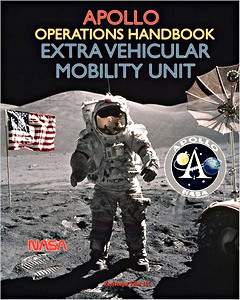
NASA Apollo - Operations Handbook - Extra Vehicular Mobility Unit (Spacesuit)

The result of eighteen years of design and research, the A7L and A7LB spacesuits served during the Apollo, Skylab and Apollo-Soyuz missions. Designed by International Latex Corporation (ILC) Dover and with a life support backpack provided by Hamilton Standard, the A7L featured a water-cooled undergarment, an inner blue pressurized layer, and a tough white nylon outer hull. After the disastrous Apollo I fire, ILC produced a version that utilized beta cloth that is fire resistant up to 650 degrees Celsius.
Two basic versions of the suit were used during Apollo: an EV A7L configuration for the command module pilot (CMP) that provided low pressure and fire protection as well as protection for free-space EVA, and the EV A7L PGA configuration that provided additional protection from the lunar surface environment. Apollo 7-14 used the A7L design that provided six hours of primary and thirty minutes of emergency life support. The longer "J" missions 15, 16 and 17 utilized the A7LB suit that extended primary life support by an hour, and also featured additional joints to facilitate operation of the lunar roving vehicle. CMPs on these missions wore A7LB based H-series A7L suits, as they needed to perform EVAs to retrieve film from the Scientific Instrument Module in "deep space". Modified A7LBs were also used during both Skylab and Apollo-Soyuz.

Created by NASA in 1968 and revised in 1971 for the Apollo 15, 16 and 17 missions, this handbook explains the extravehicular mobility unit, its subsystems, accessories and operation, as well as emergency procedures. Originally printed in two volumes by NASA, this version incorporates both in one book.

Detalle del libro

Autor:NASA
Presentación:286 páginas, 25.5 x 20.5 x 1.5 cm, tapa blanda
Ilustración:ricamente ilustrado con fotos y dibujos
Idioma:Inglés
Editorial:Periscope Film (USA, 2012)
ISBN:9781937684860
Portada del libro: NASA Apollo - Operations Handbook - Extra Vehicular Mobility Unit (Spacesuit) | Periscope

NASA Apollo - Operations Handbook - Extra Vehicular Mobility Unit (Spacesuit)

Idioma: Inglés

NASA Apollo Spacecraft - Lunar Excursion Module - News Reference

Originally created in 1971 by NASA contractor Grumman, the Apollo Spacecraft News Reference (LEM) was intended to educate members of the media, government, and private sector contractors about one of history's most ambitious undertakings. Within its pages you'll find general information about the Apollo Program, and a detailed examination of the Lunar Excursion Module and crew extra-vehicular activity procedures and equipment.(A companion book that focuses on the CM is also available.)

Scores of photos and diagrams accompany the easy-to-understand text. Chapters include: Introduction, Mission Description, Apollo Spacecraft, Lunar Module, Crew Personal Equipment, Environmental Control, Control and Displays, Guidance, Navigation, and Control, Main Propulsion, Reaction Control, Electrical Power, Communications, Instrumentation, Lighting, Portable Life Support System, Biographies, Grumman Aircraft Corp., Brief History of the LM, LM Manufacturing, Glossary, Contractors, The Moon (chapter written by Richard C. Hoagland), Index, and the LM Anatomy Booklet (reprinted in black and white).
It also includes a fascinating chapter about "LM Derivatives", showing how variations of the LM could have been built and flown in support of a wide variety of missions.

Although it may be one of the most complete studies of the systems and technology that made landing on the Moon possible, it's never been easy to find copies of this text because copies were never widely released - until now.
This reprint is of an edition featuring a mission similar to Apollo 15, 16 or 17, with astronauts performing three 7-hour EVAs using the Lunar Roving Vehicle. It features all the original text, diagrams and photos. It's a wonderful reference for the space flight fan, docent or engineering buff or for anyone else who ever wondered, "How'd they do that!"

Detalle del libro

Autor:NASA, Grumman
Presentación:296 páginas, 25.5 x 20.5 x 1.6 cm, tapa blanda
Ilustración:ricamente ilustrado con fotos y dibujos
Idioma:Inglés
Editorial:Periscope Film (USA, 2011)
ISBN:9781937684983
Portada del libro: NASA Apollo Spacecraft - Lunar Excursion Module - News Reference | Periscope

NASA Apollo Spacecraft - Lunar Excursion Module - News Reference

Idioma: Inglés

Projekt Apollo - Die Mondlandungen (Raumfahrt-Bibliothek)

"Project Apollo" is dedicated to what is probably the most ambitious space project of all time: the manned landing on the moon. The launch vehicle and the transport system had been developed in the meantime, but the actual test was now imminent.
In July 1969, a human being set foot on another celestial body for the first time. This volume of the Space Library deals with these exciting years from 1969 to the last manned flight to the moon in December 1972. A highly exciting journey through time full of setbacks and at the same time full of unbridled optimism.

Detalle del libro

Autor:Eugen Reichl
Presentación:144 páginas, 20.5 x 14 cm, tapa blanda
Ilustración:37 fotos en b/n y 96 a color
Idioma:Alemán
Editorial:Motorbuch Verlag (D, 2014)
Colección:Raumfahrt-Bibliothek
ISBN:9783613037229
Portada del libro: Projekt Apollo - Die Mondlandungen | Raumfahrt-Bibliothek | Motorbuch

Projekt Apollo - Die Mondlandungen

Idioma: Alemán

También te puede interesar:

Portada del libro: Saturn I B / Saturn V - Rocket Payload Planner's Guide

Saturn I B / Saturn V - Rocket Payload Planner's Guide

Douglas Aircraft | Inglés | tapa blanda | 142 pág. | 2012

Portada del libro: Saturn V - Flight Manual (SA 503)

Saturn V - Flight Manual (SA 503)

NASA | Inglés | tapa blanda | 262 pág. | 2011

Portada del libro: Saturn V - Flight Manual (SA 507)

Saturn V - Flight Manual (SA 507)

NASA | Inglés | tapa blanda | 250 pág. | 2012

Portada del libro: The Saturn V F-1 Engine : Powering Apollo into History

The Saturn V F-1 Engine : Powering Apollo into History

Anthony Young | Inglés | tapa blanda | 304 pág. | 2008

Portada del libro: Saturn V - Die Mondrakete

Saturn V - Die Mondrakete

Eugen Reichl | Alemán | tapa blanda | 144 pág. | 2015