Wenn Sie über unsere Links bestellen, unterstützen Sie diese Website - ohne Mehrkosten für Sie. Mehr erfahren >

Panzer - USA: Bücher - Geschichte und Modelle

Ein Buch über Panzer? Entdecken Sie hier Bildbände über die Geschichte, Modelle und Technik der Panzer aus den USA.

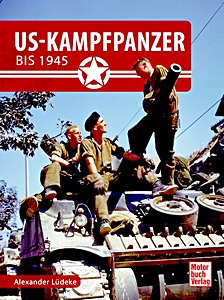
US-Kampfpanzer bis 1945

Wie die anderen Mächte auch, glaubten die Amerikaner nicht so recht an den Erfolg der Panzerwaffe, tatsächlich hielt man sie für mehr oder minder überflüssig.
Das amerikanische Panzerprogramm wurde erst mit dem Zweiten Weltkrieg kräftig angekurbelt. Es folgten zahlreiche Typen, ob sie nun Sherman, Grant, Priest hießen oder schlichtweg nur dröge Nummernbezeichnungen wie M2 oder M3 hatten: Sie waren nicht die am besten gepanzerten Fahrzeuge, aber einfach zu warten, simpel zu bedienen und hervorragend in Großserie zu produzieren.

Alexander Lüdeke stellt die wichtigsten Fahrzeuge und Modelle in bewährter Art und Weise vor.

Details

Autor:Alexander Lüdeke
Ausführung:256 Seiten, 27 x 24 x 2.2 cm, gebunden
Abbildungen:462 farbige und s/w-Abbildungen
Sprache:Deutsch
Verlag:Motorbuch Verlag (D, 2023)
ISBN:9783613045576
Cover des Buches: US-Kampfpanzer bis 1945 | Motorbuch

US-Kampfpanzer bis 1945

Sprache: Deutsch

American Tanks & AFVs of World War II

The entry of the US into World War II provided the Allies with the industrial might to finally take the war to German and Japanese forces across the world. Central to this was the focus of the American military industrial complex on the manufacture of tanks and armoured fighting vehicles.
Between 1939 and 1945, 88,140 tanks and 18,620 other armored vehicles were built - almost twice the number that Germany and Great Britain combined were able to supply.

In this lavishly illustrated volume, armour expert Michael Green examines the dizzying array of machinery fielded by the US Army, from the famed M4 Sherman, M3 Stuart and M3 Lee through to the half-tracks, armored cars, self-propelled artillery, tank destroyers, armored recovery vehicles and tracked landing vehicles that provided the armoured fist that the Allies needed to break Axis resistance in Europe and the Pacific.

Publishing in paperback for the first time and packed with historical and contemporary colour photography, this encyclopedic new study details the design, development, and construction of these vehicles, their deployment in battle and the impact that they had on the outcome of the war.

Details

Autor:Michael Green
Ausführung:376 Seiten, 24 x 19 x 3 cm, kartoniert
Abbildungen:200 s/w-Abbildungen und 50 Farbfotos
Sprache:Englisch
Verlag:Osprey Publishing (GB, 2018)
ISBN:9781472829788
Cover des Buches: American Tanks & AFVs of World War II | Osprey

American Tanks & AFVs of World War II

Sprache: Englisch

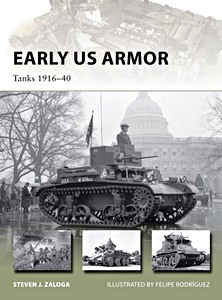
Early U.S. Armor : Tanks 1916-40 (Osprey)

Between the two World Wars, the US contributed significantly to the development of the tank, a weapon invented by the British and the French seeking a way to break through the lines of German trenches.
From the employment of the French Renault FT and British Mark V during their involvement in World War I, the US branched out with their own indigenous designs including the M1 Cavalry Car and the M2 Light and Medium tanks, the precursors to the Stuart and Grant tanks of World War II. Tank designers in this period faced unique challenges and so the story of early American armour is littered with failures amongst the successes.

Featuring previously unpublished photos and fully illustrated throughout, "Early American Armor (1): Tanks 1916-40" is essential reading for anyone interested in American armour, or in the development of tank design.

Details

Autor:Steven J. Zaloga, Felipe Rodriguez
Ausführung:48 Seiten, 25 x 18.5 x 0.5 cm, kartoniert
Abbildungen:18 s/w-Abbildungen, Zeichnungen in Farbe
Sprache:Englisch
Verlag:Osprey Publishing (GB, 2017)
Serie:New Vanguard
ISBN:9781472818072
Cover des Buches: Early U.S. Armor : Tanks 1916-40 | New Vanguard | Osprey

Early U.S. Armor : Tanks 1916-40

Sprache: Englisch

Tanks are Mighty Fine Things! - How Chrysler's Detroit Tank Arsenal Built the Tanks that helped win WWII

WWII was not just a war of weapons, but also a war of production. One of America's greatest victories on this front was certainly in the city of Detroit, where auto assembly lines were transformed into an arsenal of democracy.
Chrysler's Tank Arsenal was the nation's most spectacular war plant, a place where history was made. From it came 25,059 medium and heavy tanks of twelve different types, including the tanks that turned the tide of the war in North Africa.

Commissioned by Chrysler President K.T. Keller as a "thank you" for the men and women who made a difference, "Tanks are Mighty Fine Things" was published in 1946 and written by Wesley Stout, the former editor of the Saturday Evening Post. It features rare photographs of the Arsenal and the Sherman, Grant, Pershing and other tanks and armored vehicles it produced.

Details

Autor:Wesley Stout
Ausführung:154 Seiten, 23 x 15.5 x 0.9 cm, kartoniert
Abbildungen:zahlreiche Fotos und Zeichnungen
Sprache:Englisch
Verlag:Periscope Film (USA, 2013)
ISBN:9781937684617
Cover des Buches: Tanks are Mighty Fine Things! - How Chrysler's Detroit Tank Arsenal Built the Tanks that helped win WWII | Periscope

Tanks are Mighty Fine Things! - How Chrysler's Detroit Tank Arsenal Built the Tanks that helped win WWII

Sprache: Englisch

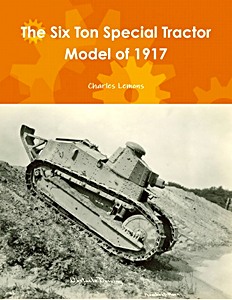
The Six Ton Special Tractor Model of 1917

This book contains a short history of the development and use of the American Model 1917 Light tank. Over 100 photographs of the tank in use and in training. Information on the units which used the tank as well as information on the painting and marking of the tank from 1919 to 1940.

Details

Autor:Charles Lemons
Ausführung:186 Seiten, 28 x 21.5 x 1.1 cm, kartoniert
Abbildungen:100+ s/w-Abbildungen
Sprache:Englisch
Verlag:Lulu Press, Inc. (USA, 2017)
ISBN:9781387086788
Cover des Buches: The Six Ton Special Tractor Model of 1917 | Lulu

The Six Ton Special Tractor Model of 1917

Sprache: Englisch

United States Tanks and Tank Destroyers of the Second World War

Only after the Nazis invaded Poland and France did the United States Government authorize mass production of tanks. By the end of the War American industry had built nearly 90,000 tanks, more than Germany and Great Britain combined.

The first big order in May 1940 was for 365 M2A4 light tanks, the initial iteration of the Stuart series, with almost 24,000 constructed. The Stuart series was supplemented by almost 5,000 units of the M24 Chaffee light tank. There was also the failed M22 Locust light tank intended for airborne operations.

The M4 series of medium tanks, best known as the Sherman, were the most numerous with some 50,000 in service with not only the American military but British and other Allied armies. It was not until later in the war that the M26 Pershing heavy tank was built.
Initially the US Army doctrine saw tanks as primarily for the exploitation role. Later the concept of tank destroyers evolved to counter large scale German armored offensives. These defensive AFVs included the half-track-based 75mm Gun Motor Carriage M3 and the full-tracked M10, M18, and M36.

This comprehensive and superbly illustrated book describes in authoritative detail the characteristics and contribution to victory of these formidable fighting vehicles.

Details

Autor:Michael Green
Ausführung:255 Seiten, 24.5 x 17.5 x 2.5 cm, gebunden
Abbildungen:200 s/w-Abbildungen
Sprache:Englisch
Verlag:Pen & Sword Books Ltd (GB, 2021)
ISBN:9781526787477
Cover des Buches: United States Tanks and Tank Destroyers of the Second World War | Pen & Sword

United States Tanks and Tank Destroyers of the Second World War

Sprache: Englisch

US Airborne Tanks 1939-1945

From their first introduction at the Battle of the Somme in the First World War, tanks proved to be one of the most important military developments in the history of warfare. Such was their influence on the battlefield, both as infantry support and as an armoured spearhead, their presence could determine the outcome of any battle. Another significant development during the 1930s was that of airborne forces, with a number of countries experimenting with air-dropped troops.
Such a concept offered the possibility of inserting soldiers behind the front lines to sow fear and confusion in the enemy's rear. However, such troops, parachuting from aircraft, could only be lightly armed, thus limiting their effectiveness. It is understandable, therefore, that much thought was given to the practicalities of air-lifting tanks that could be dropped, or deposited, alongside paratroopers.

Tanks, though, are heavy, cumbersome vehicles and before there could be any thought of carrying them by air, much lighter models would have to be produced. Charles Roberts' fascinating book opens with an investigation into the efforts in the 1930s by Britain, the Soviet Union and the USA into the development of, or adaptation of, light tanks for airborne operations. It was, inevitably, the start of the Second World War which accelerated efforts to produce an airborne tank and the means of delivery.

The use of conventional powered aircraft to carry the tanks, limited their use to existing airfields which negated their employment with airborne troops landing in the open countryside. Another method of delivery had to be found, and this took the form of the glider, which could be landed in a field behind enemy lines. The combination of light tank and glider made the aim of airborne forces being supported by armour a realistic proposition - and as a result, the 28th Airborne Tank Battalion was born.

This detailed and comprehensive study deals with every aspect of design and deployment of American airborne tanks from the earliest concepts to their actual use, by British units, on D-Day and during Operation Varsity, the Rhine crossing.

Details

Autor:Charles C. Roberts Jr
Ausführung:208 Seiten, 23.5 x 15.5 cm, gebunden
Abbildungen:100 s/w-Abbildungen
Sprache:Englisch
Verlag:Pen & Sword Books Ltd (GB, 2021)
ISBN:9781526785022
Cover des Buches: US Airborne Tanks 1939-1945 | Pen & Sword

US Airborne Tanks 1939-1945

Sprache: Englisch

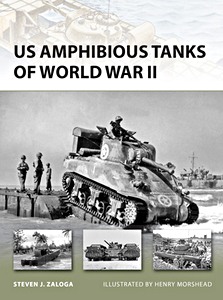
US Amphibious Tanks of World War II (Osprey)

The advent of combined arms operations in World War II created the need for specialized armored vehicles. In the case of amphibious attacks, the issue arose of how best to land tanks on a beach.
Although a variety of specialized landing craft were developed, the Dieppe raid in 1942 encouraged the development of tanks that could be deployed from further off-shore to limit the vulnerability of the LCT craft. The deep-wading equipment that they developed was first used during Operation Husky on Sicily in July 1943, and subsequently for Operations Avalanche (Salerno, September 1943), Shingle (Anzio, January 1944) and Overlord (Normandy, June 1944).

The US-manufactured DD tanks were used during Overlord by both US and British forces, and again in 1945 during the Rhine crossings. Initially, developments in the Pacific Theater were separate from those in Europe. The Marines learned from the Tarawa landings in 1943 that unprepared tanks could not be safely landed even in shallow water. DD tanks were never seriously considered for the Pacific, so other solutions were sought.

A detailed study of specialized US amphibious tanks, this is a title that will appeal to those interested in both Pacific and European Theaters, modellers and collectors.

Details

Autor:Steven J. Zaloga
Ausführung:48 Seiten, 25 x 18.5 x 0.4 cm, kartoniert
Abbildungen:Fotos und Zeichnungen (in s/w und Farbe)
Sprache:Englisch
Verlag:Osprey Publishing (GB, 2012)
Serie:New Vanguard (192)
ISBN:9781849086363
Cover des Buches: US Amphibious Tanks of World War II | New Vanguard (192) | Osprey

US Amphibious Tanks of World War II

Sprache: Englisch

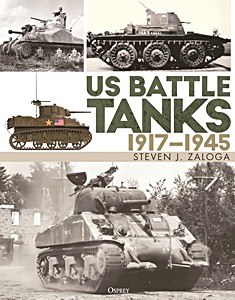
US Battle Tanks 1917-1945

Dieser erste Band einer zweiteiligen illustrierten Geschichte untersucht die Entwicklung der Kampfpanzer der US-Armee und des US Marine Corps von den frühen Experimenten im 20. Jahrhundert bis zum Ende des Zweiten Weltkriegs. Der Militärhistoriker Steven J. Zaloga verfolgt die Entwicklung amerikanischer Panzer vom Renault FT über den M4 Sherman bis zum M26 Pershing.
Basierend auf Material aus Ospreys Reihen New Vanguard, Campaign und Duel behandelt das Buch Panzerkonstruktion, Kampfeinsatz und die Erfahrungen der Besatzungen. Es vergleicht zudem amerikanische Panzer mit feindlicher Panzerung und zeigt wichtige Lehren auf, die die zukünftige Entwicklung beeinflussten.
Veröffentlicht in Zusammenarbeit mit dem AUSA Book Program, das Literatur über die Geschichte der US-Armee, Militärstrategie und Sicherheitspolitik fördert.

Inhaltsverzeichnis:
- Einleitung
- US-Panzer im Ersten Weltkrieg
- US-Panzer in der Zwischenkriegszeit
- US-Panzer im Zweiten Weltkrieg
- US-Panzer im Pazifikkrieg
- Schlussfolgerung
- Anhang: Amerikanische Panzer in Zahlen.

Details

Autor:Steven J. Zaloga, Association of the United States Army
Ausführung:272 Seiten, 25 x 20 x 2.5 cm, gebunden
Abbildungen:150 s/w-Abbildungen,75 Zeichnungen in Farbe
Sprache:Englisch
Verlag:Osprey Publishing (GB, 2024)
ISBN:9781472858825
Cover des Buches: US Battle Tanks 1917-1945 | Osprey

US Battle Tanks 1917-1945

Sprache: Englisch

US Flamethrower Tanks of World War II (Osprey)

The US Army and Marine Corps experimented with a wide range of flame-thrower tanks through World War II in both the European and Pacific theaters. Although the US Army deployment of flame-thrower tanks in the ETO was problematic at best, flamethrowers were much more widely used in the Pacific theater and became ubiquitous by 1945, including an entire Army flamethrower tank battalion on Okinawa in 1945, the largest single use of flamethrower tanks in World War II.

This book covers the initial attempts at the use of auxiliary flamethrowers by both the US Army and Marine Corps in 1943, the standardized adoption of the Satan flamethrower tank by the Marines in 1944, the development of main gun flamethrowers by the Marines and US Army based on the POA-CWS designs, and the myriad other types tested in combat including the powerful LVT-4 design using Navy flamethrowers at Peleliu in 1944. Due to the extensive Japanese use of fortifications in the final year of the Pacific war, Flamethrower tanks became one of the most important solutions in American tactics.

Details

Autor:Steven J. Zaloga, Richard Chasemore
Ausführung:48 Seiten, 24 x 18.5 x 0.5 cm, kartoniert
Abbildungen:Fotos und Zeichnungen (in s/w und Farbe)
Sprache:Englisch
Verlag:Osprey Publishing (GB, 2013)
Serie:New Vanguard (203)
ISBN:9781780960265
Cover des Buches: US Flamethrower Tanks of World War II | New Vanguard (203) | Osprey

US Flamethrower Tanks of World War II

Sprache: Englisch

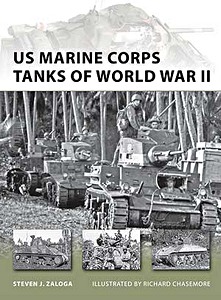
US Marine Corps Tanks of World War II (Osprey)

During World War II, the US Marine Corps formed six tank battalions that battled through the harsh conditions of the Pacific Theatre. Using the same basic tanks as the US Army, notably the M3 and M5A1 light tanks and the M4 Sherman medium tank, the marines made both technical and tactical innovations to make them more effective in the fight against the Japanese. Deep wading equipment, flamethrower tanks, and even wooden armor all became part of the Marine arsenal.

This book examines the tactics and technology that made the US Marine Corps tank service unique in the annals of warfare.

Details

Autor:Steven J. Zaloga
Ausführung:48 Seiten, 23 x 18.5 x 0.4 cm, kartoniert
Abbildungen:Fotos und Zeichnungen (in s/w und Farbe)
Sprache:Englisch
Verlag:Osprey Publishing (GB, 2012)
Serie:New Vanguard (186)
ISBN:9781849085601
Cover des Buches: US Marine Corps Tanks of World War II | New Vanguard (186) | Osprey

US Marine Corps Tanks of World War II

Sprache: Englisch

Andere Bücher in dieser Kategorie:

Cover des Buches: M24 Chaffee (Vol. 1) - American Light Tank in World War II, Korea and Vietnam | Legends of Warfare

M24 Chaffee (Vol. 1) - American Light Tank in World War II, Korea and Vietnam

David Doyle | Englisch | gebunden | 112 S. | 2019

Cover des Buches: M24 Chaffee (Vol. 2) - Chaffee-Based Vehicle Variants in the Korean War | Legends of Warfare

M24 Chaffee (Vol. 2) - Chaffee-Based Vehicle Variants in the Korean War

David Doyle | Englisch | gebunden | 112 S. | 2020

Cover des Buches: M24 Chaffee Light Tank - Technical Manual (TM 9-729)

M24 Chaffee Light Tank - Technical Manual (TM 9-729)

Department of the Army | Englisch | kartoniert | 426 S. | 2013

Cover des Buches: M24 Chaffee Light Tank 1943-85 | New Vanguard (77)

M24 Chaffee Light Tank 1943-85

Steven J. Zaloga | Englisch | kartoniert | 48 S. | 2003