Wenn Sie über unsere Links bestellen, unterstützen Sie diese Website - ohne Mehrkosten für Sie. Mehr erfahren >

Artillerie - Deutschland: Bücher - Geschichte und Modelle

Ein Buch über Artillerie? Entdecken Sie hier Bildbände über die Geschichte, Modelle und Technik der Artillerie aus Deutschland.

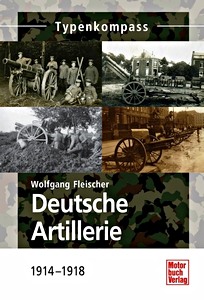
Deutsche Artillerie 1914-1918 (Typenkompass)

Obwohl von traditionellen Waffengattungen ursprünglich geschmäht, war die Bedeutung der Artillerie für die Kriegsführung in Europa immer größer geworden. Neue Entwicklungen wie gezogene Kanonenrohre im 19. Jahrhundert verbesserten Treffergenauigkeit und Reichweite der Geschosse entscheidend.

Seiten aus dem Buch [TK] Deutsche Artillerie 1914-1918 (1)

Seiten aus dem Buch "Deutsche Artillerie 1914-1918"

Im Typenkompass "Deutsche Artillerie 1914-1918" stellt Wolfgang Fleischer die ganze Vielfalt der während des Krieges zum Einsatz gekommenen Rohrartillerie vor.
Jeder Typ wird anhand eines Fotos, einer historischen Beschreibung und eines technischen Datenblatts vorgestellt.

Details

Autor:Wolfgang Fleischer
Ausführung:128 Seiten, 20.5 x 14 cm, kartoniert
Abbildungen:151 s/w-Abbildungen und 7 Farbfotos, 42 Zeichnungen
Sprache:Deutsch
Verlag:Motorbuch Verlag (D, 2013)
Serie:Typenkompass
ISBN:9783613035454
Cover des Buches: Deutsche Artillerie 1914-1918 | Typenkompass | Motorbuch

Deutsche Artillerie 1914-1918

Sprache: Deutsch

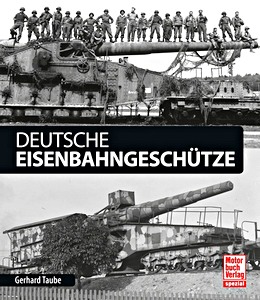
Deutsche Eisenbahngeschütze

Eisenbahngeschütze sind bekanntlich Kanonen auf Schienen. Worüber aber kaum jemand etwas weiss, ist die Vielfalt, die es von diesen Monstern auf Schienen gab. Gebaut, um auf 100 und mehr Kilometer Tod und Verderben zu bringen, galten diese Kanonen in einer Zeit, als es noch keine Raketen gab, als einziges Mittel, um hinter den feindlichen Linien Schaden anzurichten.

Seiten aus dem Buch Deutsche Eisenbahngeschutze (1)

Seiten aus dem Buch "Deutsche Eisenbahngeschütze"

Dass diese Fernwaffen meist nichts anderes waren als eine Vergeudung von Menschen und Material, steht auf einem anderen Blatt. Diese Spezialausgabe von Gerhard Taube zeigt und beschreibt Entwicklung Technik und Einsatz der deutschen Eisenbahngeschütze.

Seiten aus dem Buch Deutsche Eisenbahngeschutze (2)

Details

Autor:Gerhard Taube
Ausführung:184 Seiten, 26.5 x 23 cm, gebunden
Abbildungen:318 s/w-Abbildungen, 30 Zeichnungen
Sprache:Deutsch
Verlag:Motorbuch Verlag (D, 2017)
ISBN:9783613039759
Cover des Buches: Deutsche Eisenbahngeschütze | Motorbuch

Deutsche Eisenbahngeschütze

Sprache: Deutsch

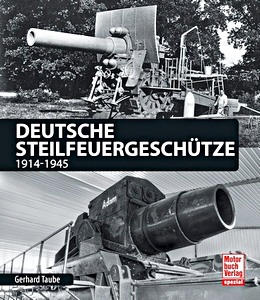
Deutsche Steilfeuergeschütze - 1914-1945

Steilfeuergeschütze wurden entwickelt, um Ziele treffen zu können, die nicht direkt im Sichtfeld liegen. Um dies zu erreichen und dabei über Hindernisse hinwegschiessen zu können, mussten sie in steilem Winkel abgefeuert werden.
Zu den bekanntesten und schwersten Steilfeuergeschützen in Deutschland gehörten die "Dicke Berta" und der Mörser "Karl". Zum Einsatz kamen sie in erster Linie gegen feindliche Festungen als "Betonknacker".

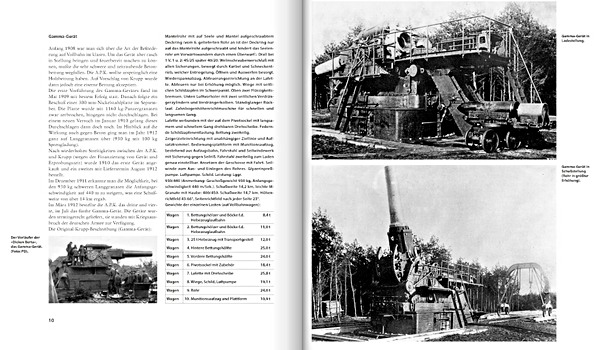
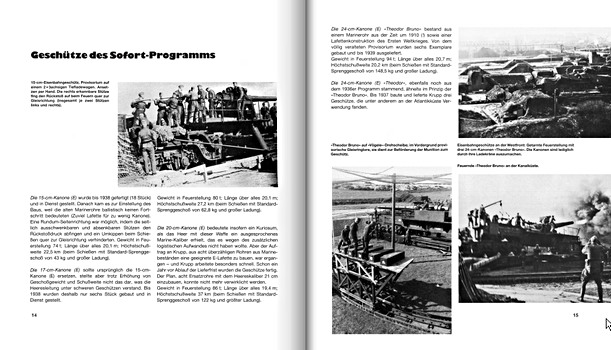
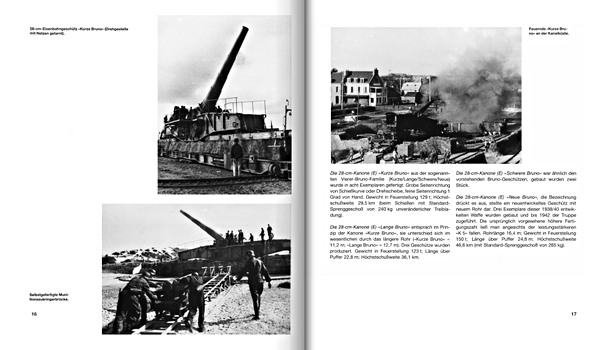
Seiten aus dem Buch Deutsche Steilfeuergeschutze - 1914-1945 (1)

Seiten aus dem Buch "Deutsche Steilfeuergeschütze - 1914-1945"

Gerhard Taube erzählt in diesem Band, wie sich diese Waffengattung entwickelt hat. Er beschreibt detailliert die Vor- und Produktionsgeschichte der schweren Kolosse sowie ihren Einsatz in den beiden Weltkriegen. Jeder Typ wird anhand eines Fotos, einer historischen Beschreibung und eines technischen Datenblatts vorgestellt.

Details

Autor:Gerhard Taube
Ausführung:192 Seiten, 26.5 x 23 cm, gebunden
Abbildungen:235 s/w-Abbildungen und Zeichnungen
Sprache:Deutsch
Verlag:Motorbuch Verlag (D, 2018)
ISBN:9783613040755
Cover des Buches: Deutsche Steilfeuergeschütze - 1914-1945 | Motorbuch

Deutsche Steilfeuergeschütze - 1914-1945

Sprache: Deutsch

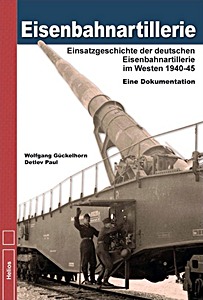
Eisenbahnartillerie : Einsatzgeschichte der deutschen Eisenbahnartillerie im Westen 1940 bis 1945 - Eine Dokumentation

In dieser Dokumentation werden die Eisenbahnartillerieeinheiten mit ihren Geschützen vorgestellt, ihre Feuerstellungen und Einsätze - mit Schwerpunkt an der belgischen und französischen Küste - und es werden Besichtigungsvorschläge zu den heute noch vorhandenen Anlagen beschrieben.

Einsatzplanungen für die 80 cm Gustav-Geschütze und für neuartige Munition (Röchling-Granaten und Peenemünder Pfeilgeschosse) werden ebenso dargestellt wie der Rückzug der Einheiten aus Belgien / Frankreich und der Verbleib der Geschütze.
Vorgestellt werden auch die Einsatzgebiete der Eisenbahnartillerie in Italien, Russland, Norwegen und in den Niederlanden. Die Beschreibungen werden ergänzt durch Übersichtskarten, Gliederungsbilder und einer Vielzahl von Fotos.

Details

Autor:Wolfgang Gückelhorn, Detlev Paul
Ausführung:288 Seiten, 29 x 21.5 x 2.5 cm, gebunden
Abbildungen:523 s/w-Abbildungen und 108 Farbfotos, 188 Zeichnungen
Sprache:Deutsch
Verlag:Helios-Verlag (D, 2014)
ISBN:9783869331164
Cover des Buches: Eisenbahnartillerie : Einsatzgeschichte der deutschen Eisenbahnartillerie im Westen 1940 bis 1945 - Eine Dokumentation | Helios

Eisenbahnartillerie : Einsatzgeschichte der deutschen Eisenbahnartillerie im Westen 1940 bis 1945 - Eine Dokumentation

Sprache: Deutsch

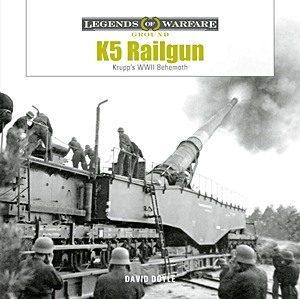
K5 Rail Gun - Krupp's WWII Behemoth (Legends of Warfare)

Known by various names such as Anzio Annie, Anzio Express, and Leopold, the German 8 cm Kanone 5 Eisenbahngeschütz (railway gun), commonly abbreviated as K5(E), stands as Germany's most successful and widely employed railway gun design.
Twenty-four of these formidable weapons, capable of shelling England from positions in France, were utilized on multiple fronts, including France, Italy, Russia, and Holland.

This illustrated book captures the operation and deployment of these fearsome weapons through 80 vintage black-and-white photos.
Complementing the historical images are over 150 full-color photos showcasing the only surviving examples, providing detailed insights into the construction nuances of these massive railway guns.

Details

Autor:David Doyle
Ausführung:128 Seiten, 23 x 23 x 1.9 cm, gebunden
Abbildungen:80 s/w-Abbildungen und 150 Farbfotos
Sprache:Englisch
Verlag:Schiffer Publishing Ltd (USA, 2023)
Serie:Legends of Warfare
ISBN:9780764366444
Cover des Buches: K5 Rail Gun - Krupp's WWII Behemoth | Legends of Warfare | Schiffer

K5 Rail Gun - Krupp's WWII Behemoth

Sprache: Englisch

The Paris Gun - The Bombardment of Paris by the German Long-range Guns and the Great German Offensives of 1918

An account of a series of bombardments of Paris by a specially built 21cm gun from a distance of some 75 miles. They began on March 23rd and ended on 9th August 1918. Over 300 shells were fired.
This is the story of a unique gun called, by the Germans, the Pariskanone and mistakenly referred to by our troops as 'Big Bertha.' The gun was 210mm calibre with a barrel length of 130 feet, an overall weight of 142 tons and a maximum range of about 80 miles. It was designed to fire on Paris bringing alarm and despondency to a population which, though subject to air bombardment had no reason to suppose they were threatened by enemy artillery.

The design, manufacture, the training of the crews and the preparation of the firing sites are all described, but the main aim of the book is to describe the four bombardments that were carried out by this weapon and the effects, material and morale wise.
The use of the Paris Gun was incorporated in the planning of the major German offensives of the first half of 1918. March 21st was the first day of the assault and at 7.20 am on 23rd March the first shot was fired. The four periods during which the gun was in action were 23 April-1 May; 27 May-11 June; 15-19 July and 5-9 August on which day the last round was fired.

The author, a Lt Col in the US Ordnance, describes each of these bombardments against a background of the ongoing German offensive and the progress of the ground forces. There are differing figures as to the total number of rounds fired but it was at least 300 and according to The Times Diary and Index of the War the total casualty figures were 196 killed 417 wounded.

N&M Press reprint (original published in 1930).

Details

Autor:Henry W. Miller
Ausführung:277 Seiten, 21.5 x 14 x 1.8 cm, kartoniert
Abbildungen:32 s/w-Abbildungen, 18 Karten
Sprache:Englisch
Verlag:Naval & Military Press Ltd (GB, 2003)
ISBN:9781843426813
Cover des Buches: The Paris Gun - The Bombardment of Paris by the German Long-range Guns and the Great German Offensives of 1918 | Naval & Military

The Paris Gun - The Bombardment of Paris by the German Long-range Guns and the Great German Offensives of 1918

Sprache: Englisch

42cm 'Big Bertha' and German Siege Artillery of World War I (Osprey)

In the early days of World War I, Germany unveiled a new weapon - the mobile 42cm (16.5 inch) M-Gerät howitzer. At the time, it was the largest artillery piece of its kind in the world and a closely guarded secret.
When war broke out, two of the howitzers were rushed directly from the factory to Liege where they quickly destroyed two forts and compelled the fortress to surrender. After repeat performances at Namur, Maubeuge and Antwerp, German soldiers christened the howitzers 'Grosse' or 'Dicke Berta' (Fat or Big Bertha) after Bertha von Krupp, owner of the Krupp armament works that built the howitzers. The nickname was soon picked up by German press which triumphed the 42cm howitzers as Wunderwaffe (wonder weapons), and the legend of Big Bertha was born.

This book details the design and development of German siege guns before and during World War I. Accompanying the text are many rare, never-before-published photographs of 'Big Bertha' and the other German siege guns. Colour illustrations depict the most important aspects of the German siege artillery.

Contents: Introduction - Design & Development - Operational History - Variants - Bibliography - Index.

Details

Autor:Marc Romanych, Martin Rupp
Ausführung:48 Seiten, 25 x 18.5 x 0.3 cm, kartoniert
Abbildungen:Fotos und Zeichnungen (in s/w und Farbe)
Sprache:Englisch
Verlag:Osprey Publishing (GB, 2014)
Serie:New Vanguard (205)
ISBN:9781780960173
Cover des Buches: 42cm 'Big Bertha' and German Siege Artillery of World War I | New Vanguard (205) | Osprey

42cm 'Big Bertha' and German Siege Artillery of World War I

Sprache: Englisch

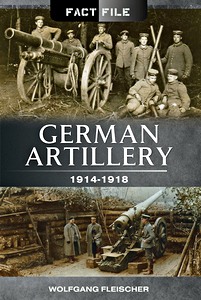
German Artillery 1914-1918 (Fact File)

The importance of artillery in warfare grew more and more throughout the nineteenth and early-twentieth centuries. New developments such as solid cannon barrels improved hit accuracy and the range of projectiles. This Fact File volume focuses on German Artillery during the Great War, when it could be argued that artillery was for the first time the dominant weapon on the battlefield. Wolfgang Fleischer discusses the diversity of artillery developed and used during the First World War by the Germans.

Details

Autor:Wolfgang Fleischer
Ausführung:128 Seiten, 20.5 x 14 cm, kartoniert
Abbildungen:151 s/w-Abbildungen und 7 Farbfotos, 42 Zeichnungen
Sprache:Englisch
Verlag:Pen & Sword Books Ltd (GB, 2015)
Serie:Fact File
ISBN:9781473823983
Cover des Buches: German Artillery 1914-1918 | Fact File | Pen & Sword

German Artillery 1914-1918

Sprache: Englisch

German Artillery in World War II, 1939-1945

Never before in German military history did the German Artillery possess such variety and magnitude as in the World War II era. From North Cape to Tobruk, Biscay to Lapland, Den Helder to the Caucasus, there were more than 1000 light and about 340 heavy artillery units, as well as the light and heavy field howitzer units, assault gun units, brigades and batteries, observation units, railroad batteries, mountain artillery units, light gun units and launcher regiments.

The German Artillery included 655,000 men in 1943, or 22 percent of all the soldiers who went into action. Thirty-nine German gun types and forty captured gun types from ten different European countries were utilized by these units.

The German Artillery took on special significance in the spring of 1943 when the fighting strength of the exhausted infantry began to decrease and armored vehicles became less and less effective in their battle against overwhelming Soviet power. During this period, the Artillery again and again provided the backbone of the German resistance and defense.

This volume of photographs presents a look into the operations, action and everyday life of the German artillery - a frequently over-looked aspect of Wehrmacht history.

Details

Autor:Joachim Engelmann
Ausführung:176 Seiten, 26.5 x 18.5 x 1.7 cm, gebunden
Abbildungen:über 400 s/w-Abbildungen
Sprache:Englisch
Verlag:Schiffer Publishing Ltd (USA, 2004)
ISBN:9780887407628
Cover des Buches: German Artillery in World War II, 1939-1945 | Schiffer

German Artillery in World War II, 1939-1945

Sprache: Englisch

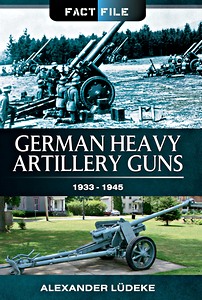
German Heavy Artillery Guns 1933-1945 (Fact File)

Covers large calibre artillery guns beyond a diameter of 75 mm, used by the Germans during the Second World War. Whilst artillery was perhaps no longer the dominant force it had been in the trench warfare of the Great War, it was nevertheless essential, both in air defence and against tanks.

This volume of the Fact File series presents the most important of the largest German artillery and air defence weapons, as well as railway guns and launchers. A meticulously researched and superbly illustrated book, which provides a compact and competent overview.

Details

Autor:Alexander Lüdeke
Ausführung:128 Seiten, 20.5 x 14 cm, kartoniert
Abbildungen:113 s/w-Abbildungen und 40 Farbfotos, 5 Zeichnungen
Sprache:Englisch
Verlag:Pen & Sword Books Ltd (GB, 2015)
Serie:Fact File
ISBN:9781473823990
Cover des Buches: German Heavy Artillery Guns 1933-1945 | Fact File | Pen & Sword

German Heavy Artillery Guns 1933-1945

Sprache: Englisch

German Heavy Mortars

Photographs and text offer a thorough account of the German heavy mortars employed during WWII.

Details

Autor:Joachim Engelmann
Ausführung:48 Seiten, 18.5 x 28 x 0.2 cm, kartoniert
Abbildungen:s/w-Abbildungen, Zeichnungen
Sprache:Englisch
Verlag:Schiffer Publishing Ltd (USA, 1991)
ISBN:9780887403224
Cover des Buches: German Heavy Mortars | Schiffer

German Heavy Mortars

Sprache: Englisch

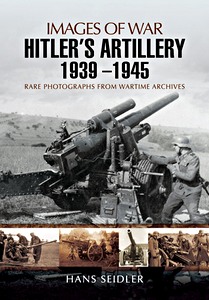
Hitler's Artillery 1939-1945 - Rare photographs from Wartime Archives (Images of War)

A highly illustrated record of the firepower of the German war machine between 1939 - 1945. Many of the photographs, all from the author's collection, come originally from the albums of individuals who took part in the war.

The images and text cover the guns in service with the Wehrmacht and Waffen-SS and provide a unique visual record of artillery pieces. These include the 7.5cm 1.IG18, the 10.5cm infantry gun, the powerful 15cm field howitzer, heavy 18cm and 21cm mortars and others including captured French, British and Russian guns.
These and other weapons are seen in action in Poland, the Low Countries, France, Balkans, North Africa, Italy and, of course, Russia.

Initially a key part of the Blitzkrieg offensive concept, the emphasis became defensive as the tide turned against the Germans. Using over 250 rare and unpublished photographs together with detailed captions and accompanying text, this book provides a unique insight into German weaponry from early Blitzkrieg campaigns to the final demise of the Nazi empire.

Details

Autor:Hans Seidler
Ausführung:160 Seiten, 24.5 x 19 x 1.3 cm, kartoniert
Abbildungen:300 s/w-Abbildungen
Sprache:Englisch
Verlag:Pen & Sword Books Ltd (GB, 2015)
Serie:Images of War
ISBN:9781783463770
Cover des Buches: Hitler's Artillery 1939-1945 - Rare photographs from Wartime Archives | Images of War | Pen & Sword

Hitler's Artillery 1939-1945 - Rare photographs from Wartime Archives

Sprache: Englisch

World War II German Super-Heavy Siege Guns (Osprey)

As the outbreak of World War II approached, Nazi Germany ordered artillery manufacturers Krupp and Rheimetall-Borsig to build several super-heavy siege guns, vital to smash through French and Belgian fortresses that stood in the way of the Blitzkrieg.
These 'secret weapons' were much larger than the siege artillery of World War I and included the largest artillery piece of the war, the massive 80 cm railway gun 'schwere Gustav' (Heavy Gustav). However, these complex and massive artillery pieces required years to build and test and, as war drew near, the German High Command hastily brought several WWI-era heavy artillery pieces back into service and then purchased, and later confiscated, a large number of Czech Skoda mortars.

The new super siege guns began entering service in time for the invasion of Russia, notably participating in the attack on the fortress of Brest-Litovsk. The highpoint for the siege artillery was the siege of Sevastopol in the summer of 1942, which saw the largest concentration of siege guns in the war.
Afterwards, when Germany was on the defensive in the second half of 1943, the utility of the guns was greatly diminished, and they were employed in a piecemeal and sporadic fashion on both the Eastern and Western Fronts.

In total, the German Army used some 50 siege guns during World War II, far more than the thirty-five it had during World War I. Supported by contemporary photographs and detailed artwork of the guns and their components, this is an essential guide to these guns, exploring their history, development, and deployment in stunning detail.

Details

Autor:Marc Romanych , Martin Rupp
Ausführung:48 Seiten, 25 x 18.5 x 0.8 cm, kartoniert
Abbildungen:zahlreiche farbige und s/w-Abbildungen
Sprache:Englisch
Verlag:Osprey Publishing (GB, 2020)
Serie:New Vanguard
ISBN:9781472837172
Cover des Buches: World War II German Super-Heavy Siege Guns | New Vanguard | Osprey

World War II German Super-Heavy Siege Guns

Sprache: Englisch

Andere Bücher in dieser Kategorie:

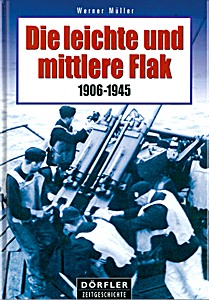
Cover des Buches: Die leichte und mittlere Flak 1906-1945

Die leichte und mittlere Flak 1906-1945

Werner Müller | Deutsch | gebunden | 176 S. | 2005

Cover des Buches: The German 88 Gun in Combat - The Scourge of Allied Armour

The German 88 Gun in Combat - The Scourge of Allied Armour

Janusz Piekalkiewicz | Englisch | gebunden | 192 S. | 1992

Cover des Buches: 88 mm FlaK 18/36/37/41 and PaK 43 1936-45 | New Vanguard (46)

88 mm FlaK 18/36/37/41 and PaK 43 1936-45

John Norris | Englisch | kartoniert | 48 S. | 2002

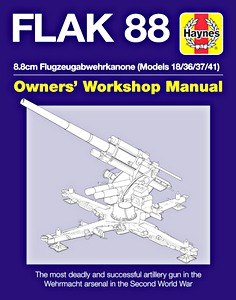
Cover des Buches: Flak 88 Manual - 8.8 cm Flugzeugabwehrkanone (Models 18/36/37/41) | Haynes Military Manual

Flak 88 Manual - 8.8 cm Flugzeugabwehrkanone (Models 18/36/37/41)

Chris McNab | Englisch | gebunden | 192 S. | 2018

Cover des Buches: German 88mm Gun vs Allied Armour : North Africa 1941-43 | Duel

German 88mm Gun vs Allied Armour : North Africa 1941-43

David Campbell, David Greentree | Englisch | kartoniert | 80 S. | 2021

Cover des Buches: The Heavy Flak Guns 1933-1945

The Heavy Flak Guns 1933-1945

Werner Müller | Englisch | gebunden | 140 S. | 2004